

Introduction – Why I Selected Marico for Financial Modeling
When building a financial model, selecting the right company is one of the most important steps. A good company for analysis should have a clear business model, consistent financial performance, strong brand recognition, and visible future growth opportunities. These factors make it easier to understand how the business operates and help create realistic projections.
For this analysis, I selected Marico Limited, one of India’s leading FMCG companies known for its strong brand portfolio and dominant presence in essential consumer product categories. Marico owns widely recognized household brands and operates in segments that are part of people’s daily routines, such as cooking oils, hair care, and wellness products.

Image Source: Money Control
One of the biggest advantages of analyzing a company like Marico is the stability of its demand. Since its products are used regularly by households, sales tend to remain relatively steady even during economic slowdowns. Businesses that sell everyday essentials are often considered defensive stocks and, over time, can become long-term compounders because they combine steady demand, strong branding, and efficient operations.
The purpose of building this financial model was not just to calculate numbers, but to deeply understand how the company actually works. Specifically, this analysis focuses on:
- How the business generates revenue – which segments contribute the most and why
- What drives its growth – whether it comes from volume, pricing, or expansion
- How margins behave over time – and what factors influence profitability
- How cash flows are generated – and whether profits translate into real cash
- Whether the stock looks attractive from a valuation perspective
In this article, I’ll walk through the entire financial modeling process step by step, using simple language and clear explanations so that even beginners can learn how to analyze a company like an investor or analyst.
You will also find my Excel financial model if you comment on my post then I will surely provide you which you can use as a learning resource if you are interested in financial analysis.
Who Should Read This Article?
This article will be useful for:
- MBA students learning finance
- Beginners in stock market investing
- Students preparing for equity research roles
- Anyone interested in understanding FMCG businesses
- Learners who want to understand DCF valuation
The language is intentionally simple so that complex finance ideas feel easy to understand.
Business Overview: Marico Limited
Marico Limited is one of India’s leading consumer goods companies, primarily operating in the beauty, wellness, and packaged consumer products segment. Over the years, the company has built a strong reputation for quality and reliability, which has helped it earn high consumer trust and brand loyalty — a major competitive advantage in the FMCG sector.

Image Source: Edukating
Marico focuses on categories that are part of everyday household consumption. Because these products are used regularly, demand tends to remain stable even during economic slowdowns. This makes the business model relatively resilient and predictable, which is one of the reasons FMCG companies are often considered defensive and long-term investment candidates.
Key Product Categories
Marico has developed a diversified portfolio across multiple consumer segments, including:
- Coconut oil
- Edible oils
- Hair oils
- Value-added hair care products
- Health-focused food products
- Male grooming products
Among these, the company holds a dominant market share in the coconut oil segment through its flagship brand. This category is particularly important because it provides steady cash flows, repeat purchases, and strong customer loyalty, which support overall financial stability.
International Presence
In addition to its strong domestic business, Marico operates in several international markets, including Bangladesh, the Middle East, Africa, and Southeast Asia. This geographic diversification is strategically important because it:
- reduces dependence on a single country or economy
- spreads business risk
- opens new growth opportunities
- allows the company to scale successful products across regions
Over time, international operations can become a major growth driver, especially if emerging markets show rising consumption trends.

Image Source: KnowTheCompanies
Focus on Innovation and Premiumization
One of Marico’s biggest strengths is its continuous focus on innovation. Instead of relying only on legacy products, the company consistently launches new offerings, especially in:
- premium product segments
- health-conscious categories
- modern lifestyle products
This strategy helps Marico stay relevant as consumer preferences evolve. It also allows the company to improve margins, since premium products typically carry higher profitability than basic commodity products.
Simple takeaway:
Marico combines stable demand, strong brands, global presence, and innovation, which makes it an excellent company to study for financial modeling and long-term business analysis.
Understanding the FMCG Industry
Marico operates in the FMCG sector, specifically in beauty and wellness. This industry has certain characteristics:
- High competition
- Strong branding importance
- Frequent consumer purchases
- Moderate pricing power
- Large distribution networks
In India, rising disposable income and increasing awareness about personal care and health have supported long-term growth in this sector.
Consumers are gradually shifting toward premium products. For example, instead of basic oil, customers may choose value-added or specialized variants. This shift helps companies improve margins.
Another important driver is rural demand. A large portion of India’s population lives in rural areas. As income levels improve, branded consumption increases.
However, the industry also faces risks such as:
- Raw material price volatility (especially copra and edible oils)
- Intense advertising expenses
- Competition from both large and local players
Despite challenges, the sector is considered relatively defensive because people continue buying essential products even during economic slowdowns.
Demand and Supply Analysis
Understanding demand and supply dynamics is essential when building a financial model because these factors directly influence revenue growth, profit margins, and future projections. For a consumer goods company like Marico Limited, analyzing these drivers helps create more realistic assumptions instead of relying on overly optimistic or unrealistic forecasts.
Demand Drivers
These factors determine how much consumers are likely to buy over time:
Population Growth
A growing population naturally leads to higher consumption of everyday products such as oils, personal care items, and packaged foods. Since Marico operates in essential categories, population expansion supports long-term demand growth.
Rising Income Levels
As incomes increase, consumers often shift from unbranded or local products to trusted branded and premium options. This trend benefits established FMCG companies that already have strong brand recognition.
Urbanization
Urban lifestyles typically increase demand for packaged, convenient, and ready-to-use products. As more people move to cities, companies like Marico gain access to a larger customer base that values convenience and brand reliability.
Health Awareness
Consumers are becoming more conscious about nutrition, wellness, and lifestyle choices. This trend supports demand for healthy food products, low-oil alternatives, and wellness-focused items, which aligns well with Marico’s product strategy.
Brand Loyalty
Strong brands encourage repeat purchases. When customers trust a product’s quality, they are less likely to switch to competitors, which helps companies maintain stable sales and predictable cash flows.
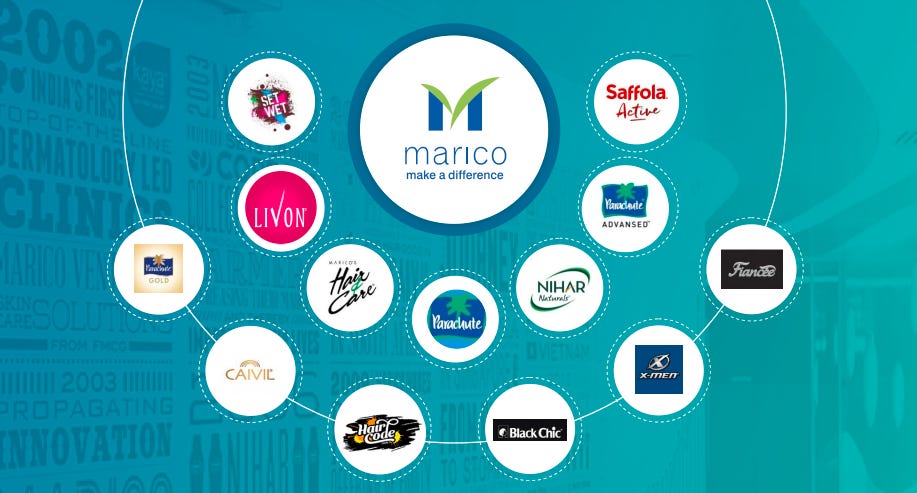
Image Source: IndianStockCommunity
Supply Factors
These determine how efficiently the company can produce and deliver its products:
Raw Material Procurement
Key inputs such as copra (for coconut oil) and edible oils play a major role in determining costs. Fluctuations in commodity prices can directly affect profit margins, making cost assumptions a critical part of financial modeling.
Manufacturing Efficiency
Efficient production systems reduce wastage, improve output, and lower costs. Companies with optimized manufacturing processes usually enjoy better operating margins.
Distribution Network
A strong distribution network ensures products reach retailers and customers quickly. Wide distribution also increases market penetration and sales volume.
Inventory Management
Efficient inventory management prevents overstocking or shortages. Good inventory control helps reduce working capital requirements and improves cash flow efficiency.
Modeling Assumption Used
While building the financial model, I assumed moderate raw material cost volatility instead of stable prices. This is a realistic approach because commodity prices rarely remain constant. Incorporating moderate fluctuations makes projections more practical and less biased, which leads to more reliable valuation results.
Simple takeaway:
Demand factors drive growth, supply factors drive profitability — and a good financial model must carefully balance both.
Future Growth Opportunities
The future growth of Marico Limited is supported by several long-term structural trends that can drive both revenue expansion and margin improvement. When building a financial model, identifying such growth drivers is important because they help determine realistic assumptions for sales projections and long-term valuation.
1. Premiumization Trend
Consumers today are increasingly shifting toward higher-quality and specialized products instead of basic commodity options. This trend is known as premiumization. As customers upgrade to value-added variants — such as advanced hair care or health-focused food products — companies can charge higher prices and improve profit margins. For Marico, premium products represent a major opportunity to increase profitability while strengthening brand perception.
2. Expansion in Rural Markets
Rural India is becoming an important growth engine for FMCG companies. Improvements in roads, logistics, digital payments, and retail infrastructure are allowing brands to reach smaller towns and villages more efficiently. As rural incomes rise, demand for branded products is expected to increase, creating a long runway for volume growth.
3. International Expansion
Marico already operates in multiple international markets, and many emerging economies still have low penetration of branded consumer goods. Expanding in regions such as Africa, Southeast Asia, and the Middle East offers long-term growth potential because these markets often grow faster than mature economies.
4. Growth Through Digital Channels
The rise of e-commerce platforms and quick-commerce apps has opened new distribution channels for consumer brands. Online platforms allow companies to reach customers directly, gather data on buying behavior, and launch targeted marketing campaigns. Digital sales can also improve margins by reducing reliance on traditional retail intermediaries.
5. Product Innovation
Continuous innovation helps companies stay relevant in changing markets. By launching differentiated and specialized products, Marico can:
- attract new customers
- retain existing users
- respond to evolving preferences
- defend market share against competitors
Innovation is especially important in FMCG because consumer preferences shift quickly, and brands that fail to adapt risk losing relevance.
Key Insights From My Financial Model
The financial model was built using historical financial statements and forward-looking assumptions.
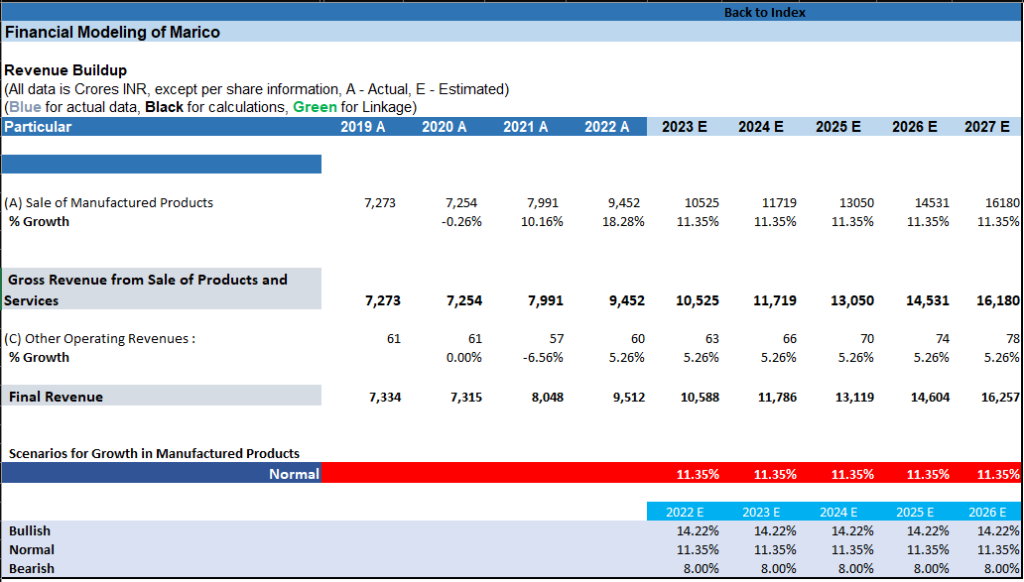
1. Revenue Projections
I projected steady revenue growth based on:
- Historical trends
- Industry growth rate
- Company ConCalls
Instead of aggressive assumptions, I used moderate growth expectations.
2. Margin Analysis
Margins were assumed to improve gradually due to better product mix and operating leverage.
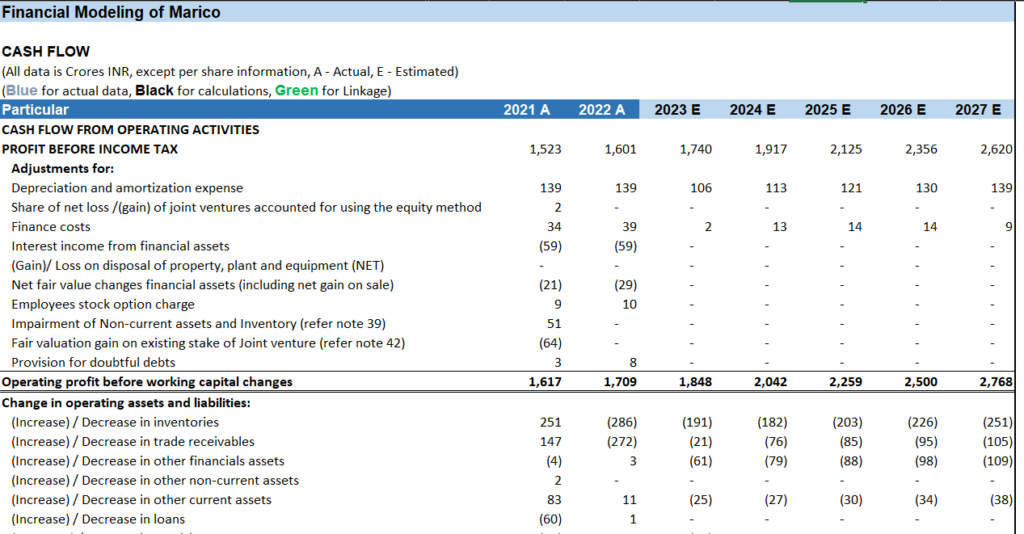
3. Cash Flow Forecasting
Marico generates healthy operating cash flows. Strong cash flow supports:
- Expansion
- Dividend payments
- Debt reduction
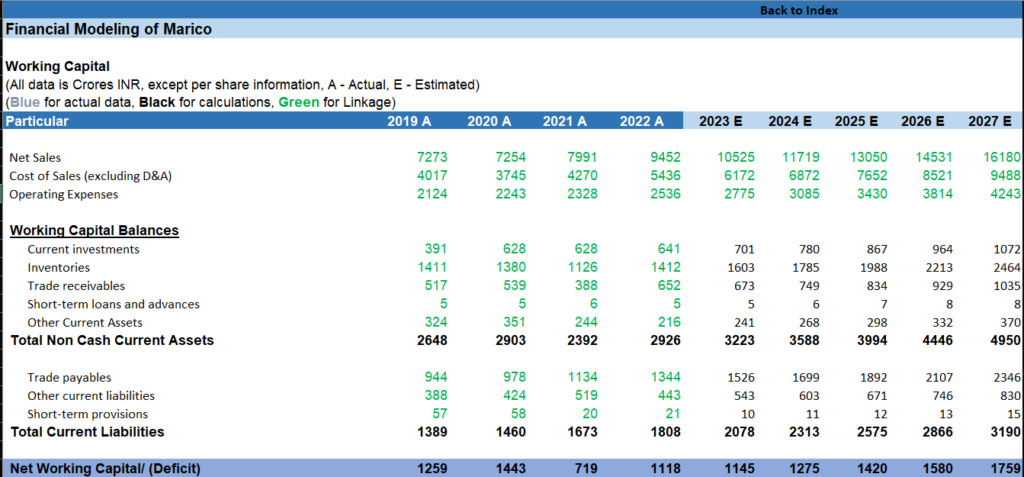
4. Working Capital Management
Efficient working capital is important in FMCG. I used inventory days, receivable days, and payable cycles based on calculations.
5. Debt Position
The company maintains a manageable debt profile, reducing financial risk.
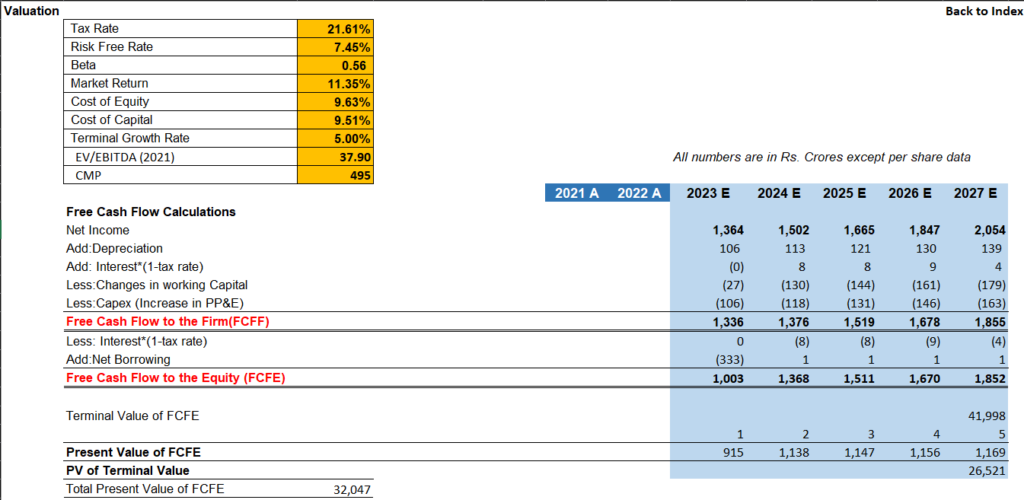
6. Valuation – Discounted Cash Flow (DCF)
I used DCF valuation to estimate intrinsic value.
Key assumptions included:
- Free cash flow growth rate
- Discount rate (cost of capital)
- Terminal growth rate
Since valuation is sensitive to assumptions, I also tested different scenarios.
Risks to Consider
No company is completely risk-free, and understanding potential downside factors is just as important as studying growth opportunities. For Marico Limited, recognizing these risks helps investors build realistic financial models and make balanced investment decisions rather than relying only on optimistic assumptions.
1. Commodity Price Volatility
Marico depends on raw materials such as copra and edible oils. If commodity prices rise sharply, input costs increase, which can reduce profit margins — especially if the company cannot immediately pass these costs on to consumers through price hikes.
2. Competitive Pressure
The FMCG sector is highly competitive, with both established brands and new entrants fighting for market share. Companies often need to spend heavily on advertising, promotions, and discounts to maintain visibility. Higher marketing expenses can impact profitability if not matched by strong sales growth.
3. Currency Risk
Since Marico earns part of its revenue from international markets, fluctuations in exchange rates can affect earnings. A strengthening domestic currency can reduce the value of overseas revenue when converted into Indian rupees, creating foreign exchange risk.
4. Execution Risk
Growth strategies such as new product launches, market expansion, or premium offerings do not always succeed. If a new product fails to gain consumer acceptance, the company may incur losses related to development, marketing, and distribution.
5. Economic Slowdowns
During economic downturns, consumers may shift from premium branded products to cheaper alternatives or smaller pack sizes. This can slow revenue growth, particularly in higher-margin premium segments.
Learning Outcomes From This Exercise
Building this model helped me understand:
- How revenue drivers affect projections
- How margins behave in FMCG businesses
- The importance of realistic assumptions
- How valuation depends on small input changes
- The importance of sensitivity analysis
This exercise strengthened my analytical thinking and understanding of business fundamentals.
Final Verdict
Marico Limited appears to be a stable, well-managed FMCG company supported by strong brand equity, consistent demand, and reliable cash flow generation. These qualities are often associated with businesses that can sustain performance across economic cycles and gradually compound shareholder value over time.
That said, valuation always matters. Even high-quality companies can become risky investments if their stock price is significantly higher than their intrinsic value. Buying a great business at an unreasonable price can limit future returns, while purchasing it at a fair or discounted valuation improves long-term investment outcomes.
Before investing, it is important for investors to:
- compare the company’s intrinsic value vs. current market price
- evaluate expected growth assumptions
- consider margin of safety
- assess their own risk tolerance and investment horizon
From a long-term perspective, companies with strong brands, disciplined management, steady demand, and efficient capital allocation often reward patient investors. Such businesses may not deliver quick gains, but they can create wealth gradually through compounding growth.
Note: This article is for educational purpose only, it provides no recommendation of any sort. I am no expert to give you any recommendation so decide accordingly.
Read More: Godrej Consumer Products Financial Model: How I Built a DCF Valuation in Excel
Read More: Is Gaudium IVF the Hottest IPO of 2026? Dates, GMP, Price Band
Pingback: Structure of a Real Estate Financial Model - The EquityVerse
Pingback: How to actually read a Financial Model - The EquityVerse