

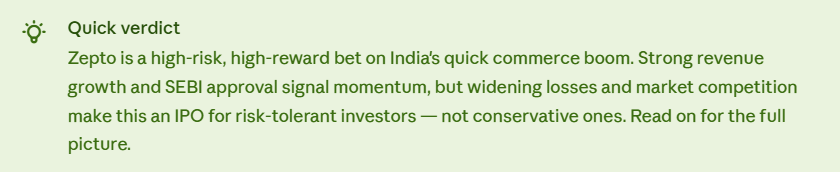
SEBI just gave the green light. Zepto’s $1.3 billion IPO is one step closer to reality — but with exploding losses and fierce rivals, is it actually worth your money? Here’s the full, honest breakdown.
What just happened?
On 8 May 2026, SEBI issued its observation letter to Zepto — the official green light for the quick commerce startup to proceed with its IPO. This is a major milestone. Zepto had filed its Draft Red Herring Prospectus (DRHP) confidentially on 2 January 2026 through SEBI’s pre-filing route, which allows companies to quietly prepare their IPO paperwork without immediately making financials public.
The IPO is expected to raise between ₹11,000–12,000 crore (approximately $1.3 billion), making it one of the biggest startup listings of 2026. The listing window most analysts are pointing to is July–September 2026, giving investors a few months to do their homework before the subscription window opens.
The Zepto story: from Stanford dropouts to IPO
Zepto was founded in 2021 by Aadit Palicha and Kaivalya Vohra — two Stanford dropouts who dropped out at age 19 to build India’s fastest grocery delivery startup. The idea was deceptively simple: build a dense network of urban micro-warehouses (called dark stores) stocked with everyday essentials, and use hyperlocal logistics to deliver them in under 10 minutes.
What followed was one of the most aggressive growth stories in Indian startup history. From zero to over 950 dark stores across 70+ cities in just four years, Zepto has raised over $2.45 billion in total funding from global investors including CalPERS, Y Combinator, Lightspeed, General Catalyst, and DST Global — at a peak valuation of $7 billion.
In late 2025, the company shifted its headquarters from Singapore back to India, converted into a public limited company, and filed its IPO papers — all in preparation for going public in 2026.
The financials: the good, the bad, and the ugly
This is the most important section for any investor. Zepto’s financials tell a classic growth-stage story — explosive top-line numbers but heavy losses on the bottom line. Here’s what the numbers actually show:
| Metric | FY24 | FY25 | Change |
|---|---|---|---|
| Total revenue | ₹4,224 Cr | ₹9,669 Cr | +129% ↑ |
| Net loss | ₹1,215 Cr | ₹3,367 Cr | +177% ↑ |
| Loss as % of revenue | ~29% | ~35% | Worsened |
| Daily orders | ~500K | 1.7M+ | +240% ↑ |
| Dark stores | ~350 | 950+ | +170% ↑ |
| Total funding raised | $2.45 billion+ | — | Net cash ~$900M |
The critical takeaway: revenue is growing fast, but losses are growing even faster. In FY25, Zepto’s net loss consumed roughly 35 paise of every rupee it earned in revenue. That said, there is a silver lining — over 60% of Zepto’s mature dark stores are now EBITDA-positive, meaning the model works when a store reaches sufficient order volume. The problem is that Zepto keeps opening new stores, which resets the clock on profitability for those locations.
Market share: Where does Zepto stand?
Zepto competes in India’s hottest consumer internet segment alongside Blinkit (owned by Eternal/Zomato) and Instamart (owned by Swiggy). Here is how the quick commerce market share currently stacks up:
Zepto and Swiggy’s Instamart are in a tight battle for second place, while Blinkit — now profitable and backed by Zomato’s deep pockets — holds a commanding lead. Crucially, Blinkit has already crossed the profitability threshold, which sets a clear benchmark that public market investors will use to judge Zepto.
IPO structure: fresh issue or offer for sale?
Unlike the Jio IPO (which is primarily an OFS), Zepto’s IPO is expected to be predominantly a fresh issue — meaning the money raised goes directly into the company’s balance sheet to fund expansion. A small OFS component will allow early investors to partially exit.
This is generally a positive sign. It means Zepto needs the capital to grow, not that insiders are rushing to cash out. The fresh issue proceeds are expected to be used for new dark store expansion, technology infrastructure, and working capital needs.
| SEBI approval | Received — 8 May 2026 |
| Issue size | ₹11,000–12,000 crore (~$1.3B) |
| Issue type | Fresh issue + limited OFS |
| Expected valuation | $5.6B–$7B (under review) |
| Reservation split | QIB 75% · NII 15% · Retail 10% |
| GMP (grey market premium) | Not yet available |
| Price band / lot size | Pending final RHP |
| Expected listing window | July–September 2026 |
| Lead managers | Morgan Stanley, Goldman Sachs, Axis Capital, HSBC, JM Financial, IIFL, Motilal Oswal |
| Listing exchanges | NSE + BSE |
A note on GMP: Since the price band has not yet been announced and the final RHP is still pending, no official grey market premium data is available yet. GMP activity typically begins building 7–10 days before the IPO subscription opens. Once the price band is announced, track live GMP on credible IPO tracking portals.
Strengths and Risks
- Revenue doubled to ₹9,669 Cr in FY25 — one of India’s fastest-growing consumer startups
- 1.7 million daily orders; 100M+ app installs on Google Play alone
- 60%+ of mature dark stores are EBITDA-positive, showing the model works at scale
- India’s quick commerce market expected to reach $35–100B by 2030
- ~$900M in net cash — substantial runway even without IPO proceeds
- Mostly fresh issue — money goes to the company, not early investors cashing out
- Founded in 2021; listing in 2026 makes it one of India’s youngest-ever mega IPOs
- Net loss rose 177% to ₹3,367 Cr in FY25 — losses are growing faster than revenue
- Losses equal 35% of revenue — capital intensity remains very high
- Blinkit (Eternal) already profitable; Zepto has no near-term profitability timeline
- Only ~10% reserved for retail investors — allotment probability will be very low
- IPO valuation may be reset downward by 15–20% from the $7B private round
- Regulatory scrutiny over dark patterns and aggressive discounting practices
- Intense 3-way competition with well-funded Blinkit and Swiggy’s Instamart
The Bigger Context: Quick Commerce’s Moment
Zepto’s IPO is arriving at a pivotal moment for India’s quick commerce industry. The sector has grown 24 times between 2022 and 2025, reaching $7.4 billion in GMV, and analysts project it could hit $35–100 billion by 2030. India’s urban population is increasingly dependent on 10-minute delivery for groceries, medicines, electronics, and more — a behaviour shift that is structural, not just a pandemic-era blip.
The Zepto IPO, if successful, will also serve as a major benchmark — setting the tone for how Indian public markets value high-growth-but-loss-making quick commerce businesses. This matters not just for Zepto investors but for the entire Indian new-age tech listing ecosystem going forward.
Disclaimer: This article is for informational and educational purposes only. It does not constitute financial or investment advice. IPO details are subject to change. Always read the final DRHP carefully and consult a SEBI-registered financial advisor before applying to any IPO.
Read More: Jio IPO 2026: Everything You Need to Know Before India’s Biggest Listing
Pingback: India's Defence Stocks Are on Fire — Most Investors Are Still Sleeping - The EquityVerse