

When people talk about finding the real value of a stock, one method comes up again and again — DCF valuation.
You might have heard statements like:
- “This stock is undervalued based on DCF”
- “DCF value is much higher than the current market price”
But for beginners, DCF often sounds too complex, too mathematical, or only for analysts.
In reality, once you understand the logic behind it, DCF (Discounted Cash Flow) valuation is very intuitive.
In this article, we’ll:
- Understand what DCF valuation is
- Learn why it is important
- Break down the DCF formula in simple words
- Do a step-by-step DCF valuation using an Indian company example
- Discuss limitations of DCF
Let’s start from the basics.
What is DCF Valuation?
DCF stands for Discounted Cash Flow.
In simple words:
DCF valuation estimates the intrinsic value of a company based on the cash it is expected to generate in the future.
The key idea is:
A company is worth the cash it will generate for its owners
Future cash is worth less than today’s cash
So, we “discount” future cash flows to today’s value
That’s it. That’s the core logic.
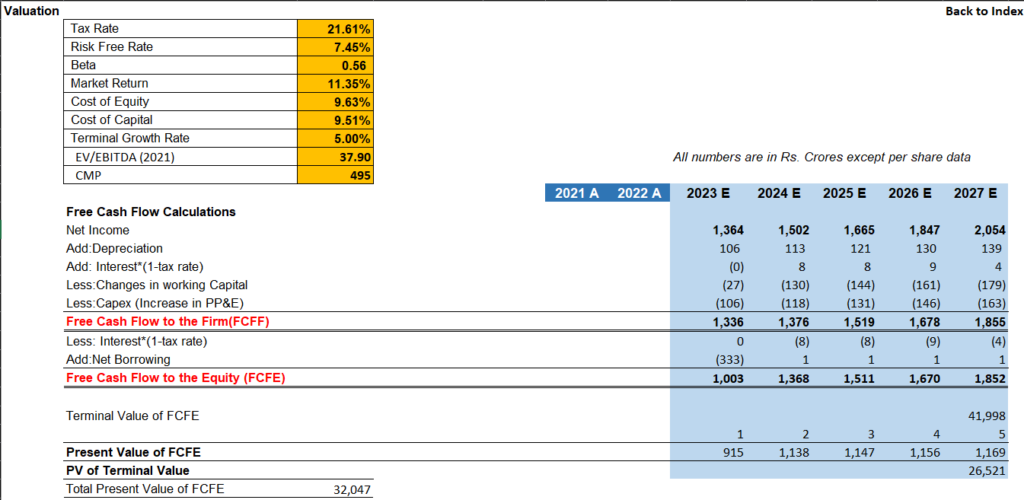
Why is DCF Valuation Important?
Stock prices move daily because of:
- News
- Emotions
- Market sentiment
- Short-term results
But intrinsic value doesn’t change every day.
DCF helps you:
- Estimate the true value of a business
- Avoid overpaying for hype stocks
- Make long-term, fundamentals-driven decisions
Investors like Warren Buffett focus heavily on cash flows — and DCF is built exactly around that concept.
Key Concepts You Must Know Before DCF
Before jumping into calculations, let’s understand a few important terms.
1️⃣ Free Cash Flow (FCF)
Free Cash Flow is the cash a company generates after taking care of operating expenses and capital expenditure.
In simple terms:
Cash left after running and maintaining the business
This is the cash available for:
- Shareholders
- Debt repayment
- Expansion
2️⃣ Growth Rate
This is the rate at which you expect the company’s cash flows to grow in the future.
Growth depends on:
- Industry potential
- Company size
- Competitive advantage
- Past performance
3️⃣ Discount Rate
The discount rate represents:
- Risk of the business
- Opportunity cost
- Expected return from the investment
In India, investors often use:
- 10–14% for stable companies
- Higher for risky businesses
4️⃣ Terminal Value
Companies don’t stop operating after 5 or 10 years.
Terminal value estimates the value of all future cash flows beyond the forecast period.
DCF Formula (Simple Explanation)
At a high level:
Intrinsic Value = Present value of future cash flows + Present value of terminal value
You don’t need to memorize formulas — focus on understanding the flow.
DCF Valuation: Indian Company Example
Let’s take a hypothetical example inspired by a stable Indian company (numbers simplified for learning).
📌 Step 1: Assume Current Free Cash Flow
Assume the company generates:
Free Cash Flow (FCF) = ₹1,000 crore
📌 Step 2: Estimate Growth Rate
Based on:
- Industry growth
- Company history
We assume:
FCF growth = 10% per year for next 5 years
Projected cash flows:
| Year | Free Cash Flow (₹ crore) |
|---|---|
| Year 1 | 1,100 |
| Year 2 | 1,210 |
| Year 3 | 1,331 |
| Year 4 | 1,464 |
| Year 5 | 1,610 |
📌 Step 3: Choose Discount Rate
Let’s assume:
Discount rate = 12%
This reflects business risk + expected return.
📌 Step 4: Discount Future Cash Flows
Now, we convert future cash into today’s value.
(Conceptually — future money is worth less today.)
After discounting:
| Year | Discounted FCF (₹ crore) |
|---|---|
| Year 1 | 982 |
| Year 2 | 965 |
| Year 3 | 949 |
| Year 4 | 931 |
| Year 5 | 914 |
Total present value of 5-year cash flows ≈ ₹4,741 crore
📌 Step 5: Calculate Terminal Value
Assume:
Long-term growth rate = 4%
Terminal Value formula (simplified conceptually):
Terminal Value = Final year FCF × (1 + growth) ÷ (discount rate − growth)
Terminal Value ≈ ₹27,800 crore
Discounting this to today’s value:
Present value of terminal value ≈ ₹15,800 crore
📌 Step 6: Calculate Enterprise Value
Enterprise Value = 4,741 + 15,800 = ₹20,541 crore
📌 Step 7: Adjust for Debt and Cash
Assume:
Debt = ₹3,000 crore
Cash = ₹1,000 crore
Equity Value = 20,541 − 3,000 + 1,000 = ₹18,541 crore
📌 Step 8: Calculate Intrinsic Value Per Share
Assume:
Total shares = 10 crore
Intrinsic value per share = ₹1,854
How to Use DCF as an Investor
Now compare:
Market price vs Intrinsic value
If:
Market price = ₹1,300
DCF value = ₹1,854
➡️ The stock may be undervalued
But remember — DCF is not a guarantee, it’s an estimate.
Where DCF Can Go Wrong
DCF is powerful, but not perfect.
❌ Sensitive to Assumptions
Small changes in:
- Growth rate
- Discount rate
…can change valuation significantly.
❌ Not Suitable for All Companies
Avoid DCF for:
- Loss-making companies
- Highly cyclical businesses
- Early-stage startups
❌ Overconfidence Risk
DCF gives a number — not certainty.
Always combine DCF with:
- Business quality analysis
- Financial ratios
- Management evaluation
Best Practices for Beginners
- ✔ Be conservative with growth
- ✔ Use higher discount rates if unsure
- ✔ Do scenario analysis (best/worst case)
- ✔ Never rely on DCF alone
DCF is a tool, not a prediction machine.
Final Thoughts
DCF valuation helps you think like a business owner, not a trader.
It forces you to ask:
- How much cash will this company generate?
- How risky is that cash?
- Am I paying a fair price today?
You don’t need perfect accuracy — you need reasonable assumptions and discipline.
With practice, DCF becomes one of the most powerful tools in your investing toolkit.
Read More: Innovision IPO: Revised Price Band, Latest GMP, Dates & Full Review (2026)