

Before learning Excel, valuation, or models, you must understand one simple thing:
“How does a property actually generate money?”
If this concept is clear then:
- Modelling becomes easy
- Valuation makes sense
- Bad investments can be avoided
Two Main Ways Real Estate Makes Money
Real estate earns money mainly in two ways:
1️⃣ Rental Income (Regular Income)
2️⃣ Capital Appreciation (Value Increase)
Let’s understand both slowly and clearly.
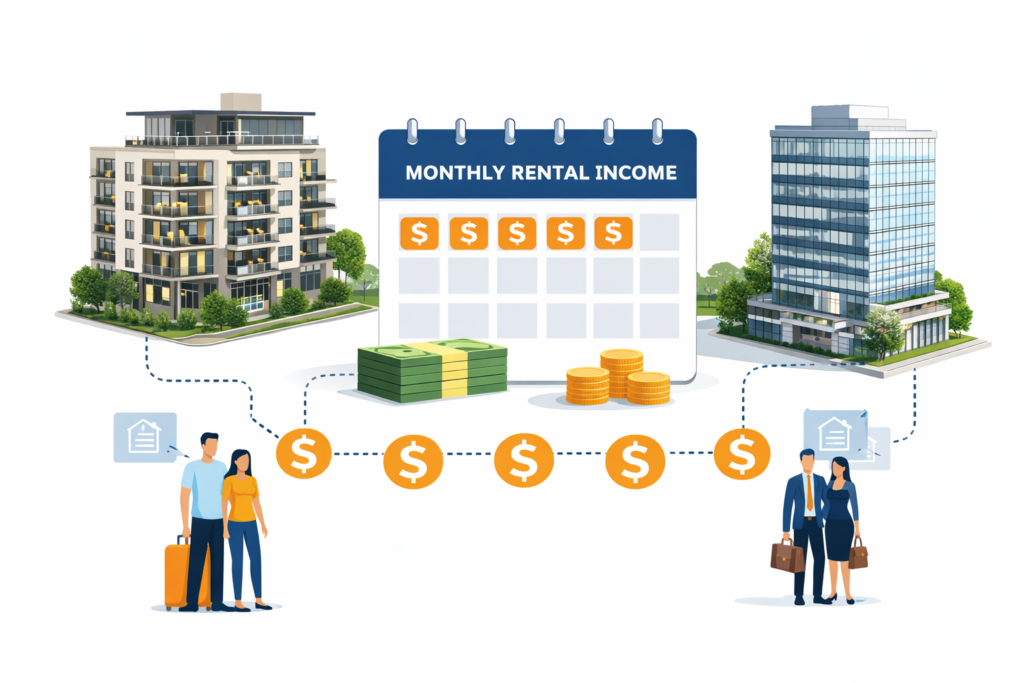
1. Rental Income
What is Rental Income?
Rental income is the money you receive regularly by giving your property on rent.
Examples:
- Flat → monthly rent
- Shop → monthly rent
- Office → yearly or monthly lease rent
👉 This is cash coming into your pocket regularly.
Simple Example
Monthly rent = ₹25,000
Yearly rent = ₹25,000 × 12 = ₹3,00,000
This ₹3,00,000 is your gross rental income.
Gross Income vs Actual Income
You may think: “₹3,00,000 is my income”
But real estate is not that simple my friends.
Here are the problems:
- Property may stay empty
- Tenants may delay rent
- Expenses exist
Simple Example
Flat empty for 1 month
Rent lost = ₹25,000
So actual rent received:
₹3,00,000 – ₹25,000 = ₹2,75,000
👉 This is why vacancy matters in modelling.
Operating Expenses (Money Going Out)
Every property has expenses.
Common Expenses:
- Maintenance charges
- Property tax
- Insurance
- Repairs
- Management fees
Simple Example
Annual rent received = ₹2,75,000
Annual expenses = ₹75,000
Now calculate:
Net Operating Income (NOI)
NOI = Rent – Operating Expenses
NOI = ₹2,75,000 – ₹75,000 = ₹2,00,000
Net Operating Income (NOI) – The Most Important Concept
NOI is the real income generated by a property before loan payments.
Why NOI is important:
✔ Used for property valuation
✔ Used to calculate returns
✔ Used by banks & investors
👉 NOI is the backbone of real estate modelling.
2. Capital Appreciation
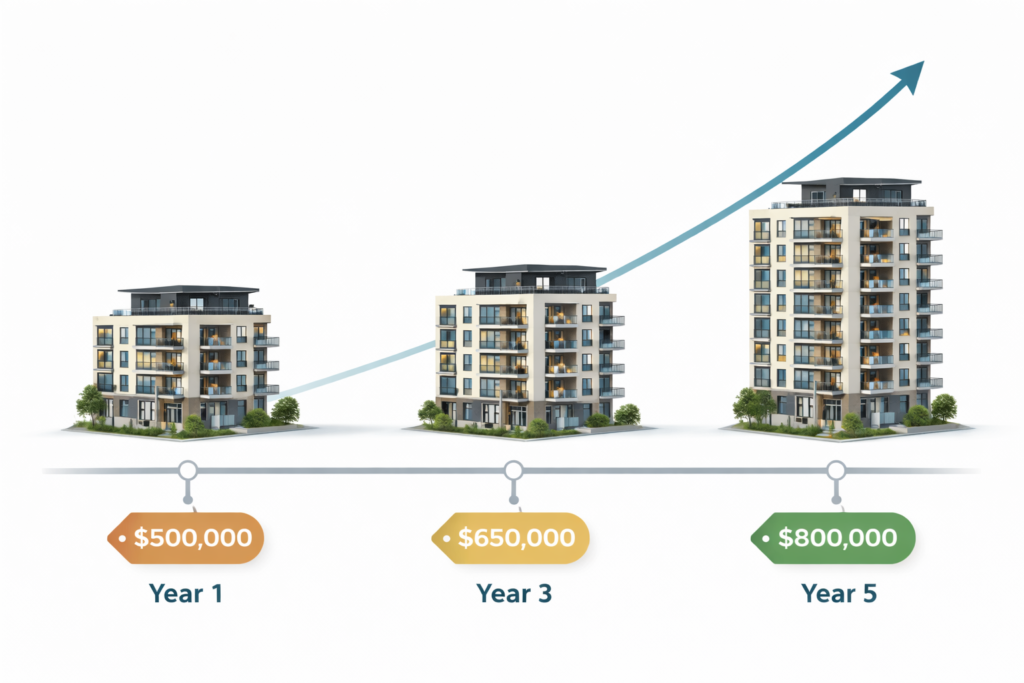
Capital appreciation means increase in property value over time.
Example
Purchase price = ₹50 lakh
Value after 10 years = ₹80 lakh
Capital appreciation:
₹80L – ₹50L = ₹30 lakh
👉 This profit comes only when you sell.
Now Combining Both: Real Profit in Real Estate
Real estate profit = Rental Income + Capital Appreciation
Full Example
Annual NOI = ₹2,00,000
Holding period = 10 years
Total rental income = ₹20,00,000
Purchase price = ₹50 lakh
Sale price = ₹80 lakh
👉 Total Profit = ₹20L + ₹30L = ₹50L
Cash Flow Concept (Beginner Friendly)
What is Cash Flow?
Cash flow = Money left in your hand after all payments
Types of Cash Flow:
- Before Loan (Unlevered Cash Flow)
- After Loan (Levered Cash Flow)
Example with Loan:
NOI = ₹2,00,000
EMI per year = ₹1,50,000
Cash flow:
₹2,00,000 – ₹1,50,000 = ₹50,000
👉 This ₹50,000 is actual money you earn yearly.
Money Flow in Real Estate
Tenant → Rent → Expenses → NOI → Loan → Cash Flow → Investor
Income Property vs Non-Income Property
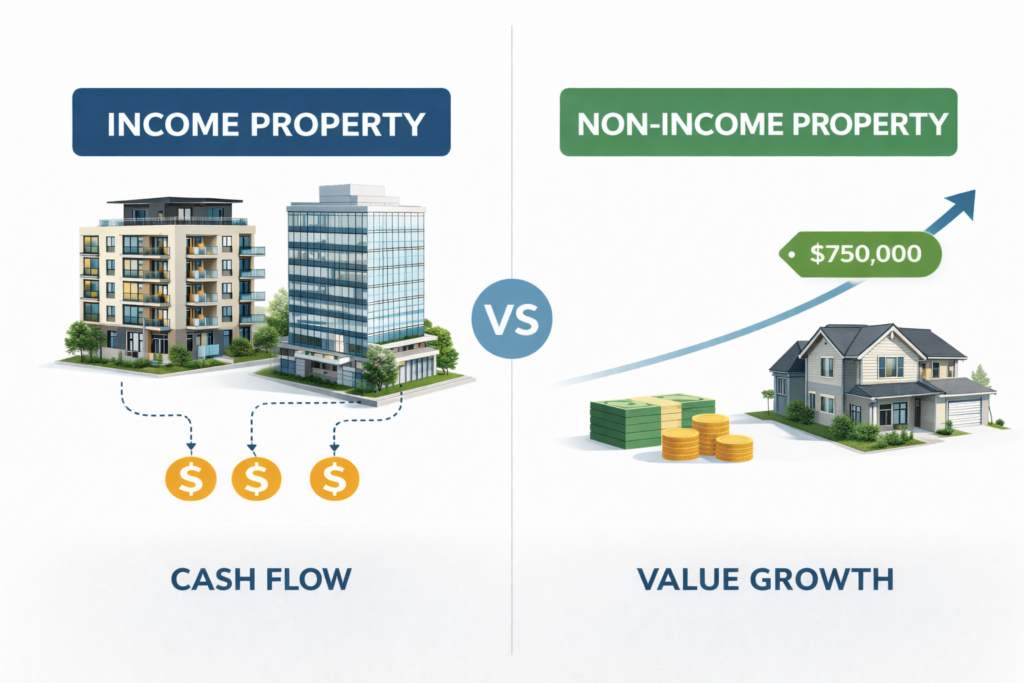
Income Property
- Rented flat
- Office building
- Shops
💡 Generates regular cash flow
Non-Income Property
- Self-occupied house
- Empty land
💡 Mainly depends on appreciation
Mini Case Study: Rent vs Appreciation
Case A: High Rent, Low Appreciation
Rent = ₹30,000/month
Price growth = 3%
Case B: Low Rent, High Appreciation
Rent = ₹15,000/month
Price growth = 7%
❓ Which is better?
👉 Answer depends on your goal, and this is exactly why financial modelling is needed.
Key Takeaways of this post:
- Real estate earns money from rent + appreciation
- Rent is not equal to profit (expenses & vacancy matter)
- NOI is the most important income measure
- Cash flow is what investor actually earns
- Different properties suit different investors
What Comes Next?
In the next chapter, you’ll learn:
- All important real estate terms
- Words used by professionals
- Terms you must know before touching Excel
Read More: Introduction to Real Estate & Financial Modelling
Pingback: Introduction to Real Estate & Financial Modelling - The EquityVerse
Pingback: Basic Real Estate Terminologies (Must-Know Concepts) - The EquityVerse