

Investing in the stock market is one of the most powerful ways to build long-term wealth. Yet, every year, lakhs of new investors enter the markets and a large percentage end up losing money.
But why does this happen?
Is the stock market risky?
Or do people simply make the wrong decisions?
The truth is very simple:
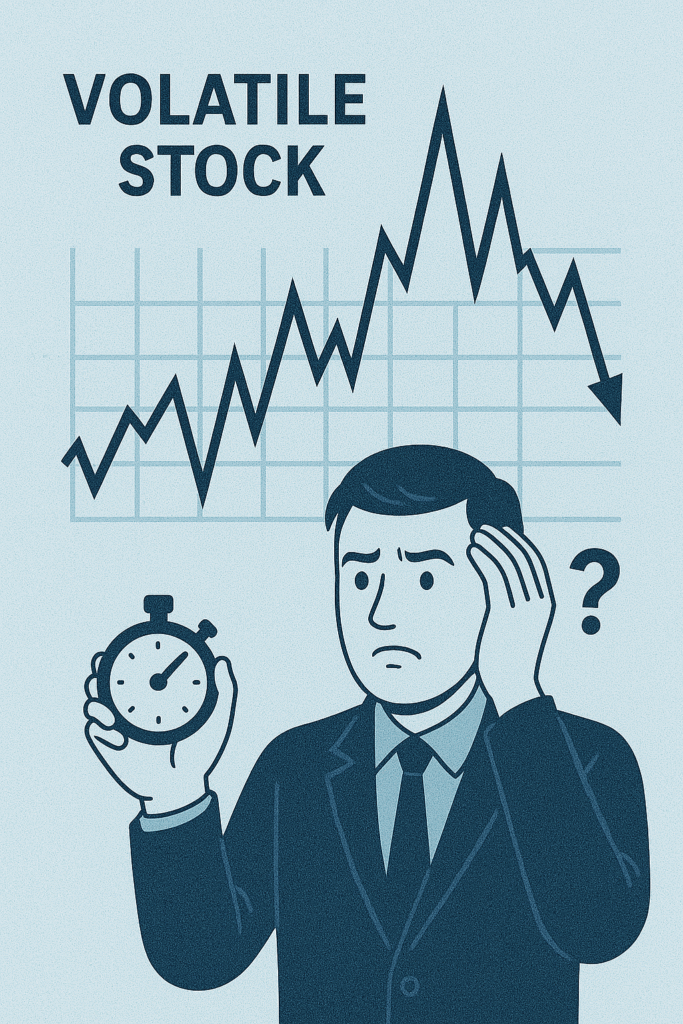
- People don’t lose money because market is too risky.
- They lose money because of their own behaviour.
Here in this article, I’ll break down the 10 most common mistakes investors make — the same mistakes that often destroy portfolios, confidence, and long-term wealth potential.
If you can avoid these, then your probability of success increases dramatically.
Let’s start with the first one:
1. Investing Without a Clear Goal
Most beginners start investing because:
- “Stock market is trending…”
- “My friend made profit, so I should too…”
- “I saw a stock tip on social media…”
These are not the right intent to get started, you will get hurt definately.
The problem arises?
People don’t know why they are investing.
A portfolio without a goal is like driving without a destination, you will reach where you might not supposed to be.
Examples of clear goals:
- “I want to build ₹15 lakh in 5 years.”
- “I want to invest ₹5,000 every month for long-term wealth.”
- “I’m saving for my child’s education.”
Why it matters:
Your goals determine:
- What stocks you choose
- How much risk you take
- What allocation you follow
Without goals, you end up buying random stocks and panicking when they fall.
2. Following Tips, Trends, and Social Media Hype
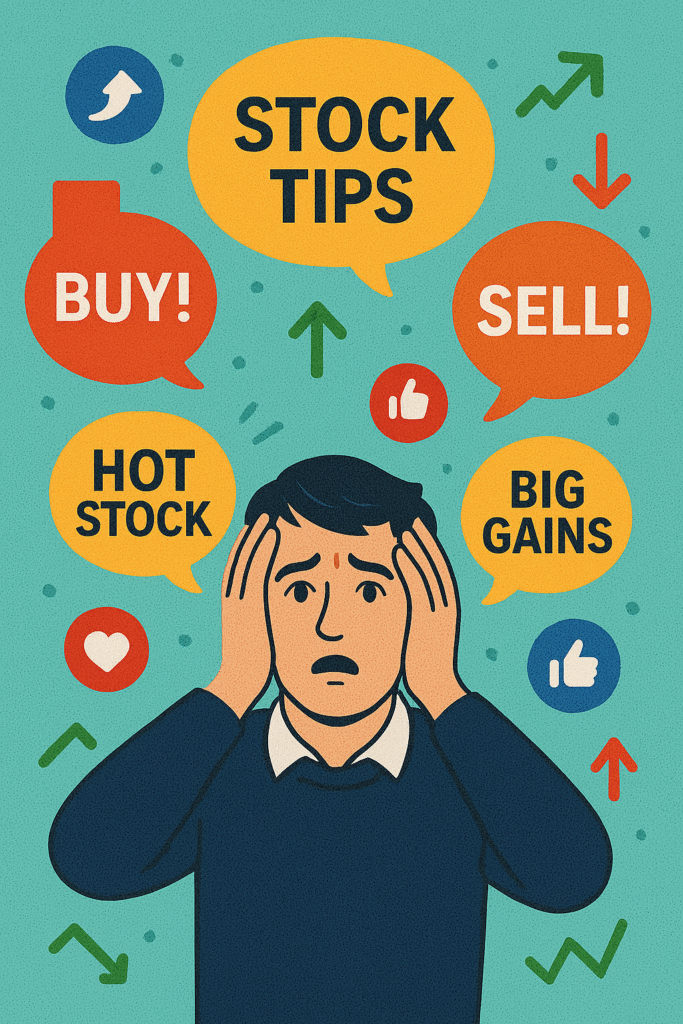
This is the #1 reason people lose money. People want shortcuts and these shortcuts are mostly find in social media.
Social media is filled with:
- Viral stock tips
- Telegram/Instagram “gurus”
- People showing ₹10,000 profit screenshots, but what you don’t see are the losses.
Most people buy because:
- A stock is trending
- Someone said “This will go up 50%!”
- They fear missing out (FOMO)
What usually happens?
You buy high → hype fades → stock falls → you panic sell.
Result: Loss ⚠️
Always remember:
If you’re buying because someone else told you, you are already late. Hearing from someone and then executing will only get you in trouble. Think what you are doing with your money.
3. No Knowledge About the Business
Mostly people invest in stocks that they don’t understand, usually they think:
- “Tech stock hai, surely accha hoga.”
- “Small cap hai, 10x return dega.”
- “Naam suna hai, company badhi hogi.”
But when the price crashes, they don’t know why.
Before buying a stock, ask yourself:
- What does the company sell?
- How does it make money?
- Who are the competitors?
- Is the business stable?
- Does the company have a long-term future?
If you can’t explain the business in simple words, then you shouldn’t invest in it.
4. No Diversification — Putting All Money in 1–2 Stocks
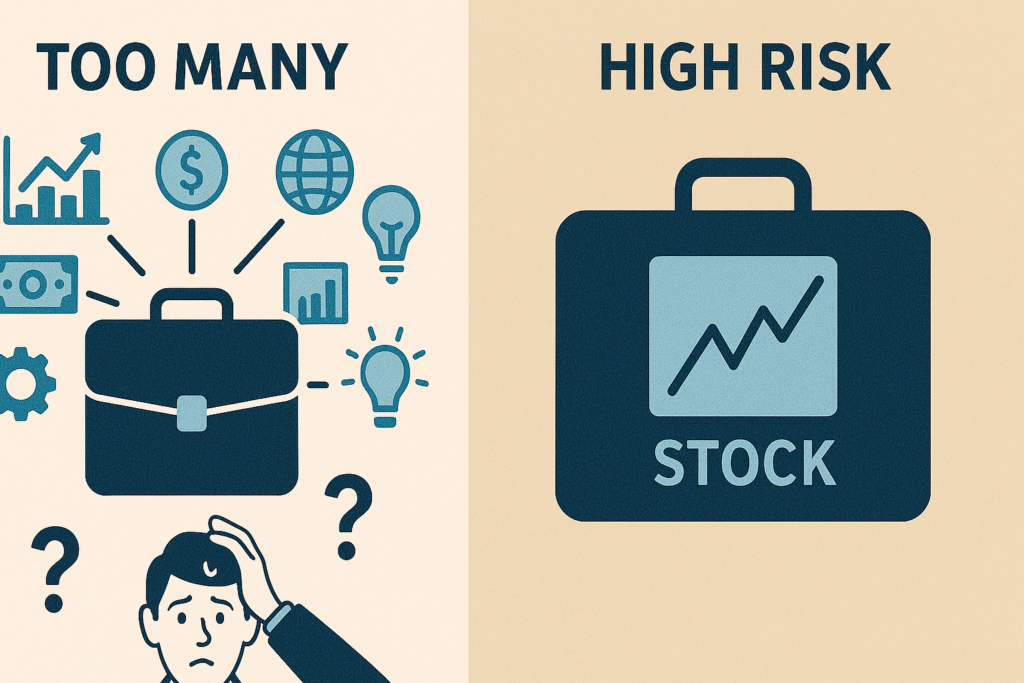
New investors often put 70–100% of their money into:
- A trending small cap
- A “sure shot” stock
- A sector they like emotionally
When such a stock crashes, the entire portfolio collapses.
A healthy portfolio begins with:
- Large caps: Stability
- Mid caps: Growth
- Small caps: High-risk, high-reward
- ETFs: Low cost and diversified
Diversification protects you from big losses — without reducing long-term returns.
5. Trying to Get Rich Quickly
The idea of earning “easy money” brings many people to the stock market.
Common behavior:
- Expecting profits in days
- Buying highly volatile stocks
- Chasing 5x–10x returns instantly
- Jumping into penny stocks
Result?
90% of the time — losses.
The stock market rewards:
- Discipline
- Patience
- Consistency
- Long-term thinking
- Not gambling.
If you want quick money → the stock market is not the place.
If you want serious wealth → stay invested for years.

6. No Understanding of Risk
Many investors focus only on:
“Return kitna milega?”
Not:
- “Risk kitna hai?”
- “Downside kya ho sakta hai?”
- “Worst case scenario kya hoga?”
Examples:
- Small caps can fall 60–70% in a bad year
- Cyclical stocks depend heavily on economic cycles
- High-debt companies collapse fast
- IPOs can list at a discount
Smart investors always protect the downside first.

7. Panic Selling During Market Corrections
The biggest mistake:
- People sell at the bottom.
- They buy stocks when markets are rising and everybody is optimistic.
- Then when markets fall 10–20% (a normal correction), they panic and sell everything.
Why this happens:
- They invested without understanding the stock
- They invested money they needed urgently
- They bought at the peak due to FOMO
- They were not mentally prepared for volatility
Remember:
- Corrections are temporary.
- Growth is long term.
Even the Nifty/Sensex have corrected 50% multiple times but have always recovered to new highs.
8. Not Reviewing or Rebalancing the Portfolio
Many investors:
- Buy a few stocks
- Leave them untouched
- Never review performance
- Never rebalance sectors
- Never compare with market benchmarks
Your portfolio is like a living organism — it needs maintenance.
You should review it:
- Every 6–12 months
- After major sector changes
- When a business fundamentally changes
- If the allocation becomes unbalanced (e.g., one stock becomes 40% of your total)
Rebalancing keeps your risk under control and prevents major losses.
9. Investing Money You Can’t Afford to Lose
This is a dangerous mistake you can ever do.
People invest:
- Emergency funds
- Rent money
- Borrowed money
- Credit card money
- Money needed soon
Then when markets fall…
They are forced to sell at a loss.
Your investment capital should always come from:
- Savings
- Surplus income
- Money you don’t need for at least 3–5 years
This gives you the freedom to stay patient and ride out the volatility.
10. Ignoring Fundamentals and Focusing Only on Price
Many beginners care only about:
- “Ye stock kitna gira?”
- “Kitna upar jayega?”
- “Iska chart kaisa hai?”
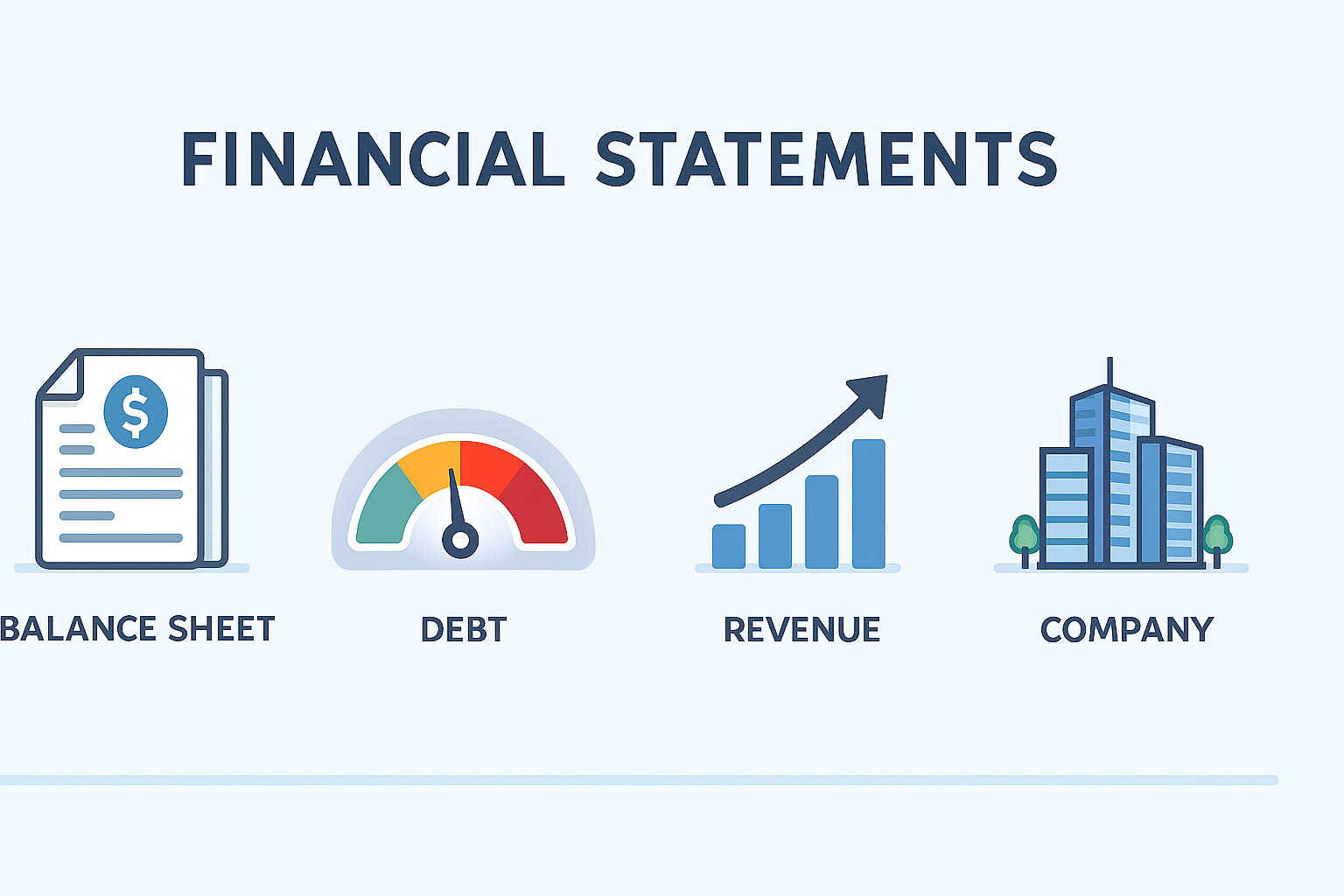
But they ignore:
- Revenue growth
- Profit trends
- Debt levels
- Management quality
- Cash flow
- Industry outlook
Stocks are not just “numbers on a chart”.
They represent real businesses.
If the business is good → the stock will eventually do well.
If the business is weak → no chart pattern can save it.
The market follows earnings — always.
Bonus: The Emotional Trap
The biggest enemy of investors is not the market.
It is their own emotions.
- Greed (buying too much, too fast)
- Fear (selling too early)
- Overconfidence (thinking you know everything)
- Impatience (wanting quick results)
- Regret (comparing with others)
- Anger (revenge trading after a loss)
Master your emotions → You master the market.
How to Avoid These Mistakes — A Simple Framework
Here is a simple formula you can follow:
✔ Step 1: Know your goal
Long-term? Short-term? Wealth creation? Income?
✔ Step 2: Follow asset allocation
Large cap + mid cap + small cap + ETF.
✔ Step 3: Do your research
Use tools like:
- Screener
- TickerTape
- Trendlyne
- Moneycontrol
✔ Step 4: Stay consistent
Even ₹1,000 monthly SIP is powerful.
✔ Step 5: Don’t check the portfolio daily
Weekly or monthly check is enough.
✔ Step 6: Review every 6–12 months
Rebalance if needed.
✔ Step 7: Stay for the long term
Let compounding work its magic.
Final Thoughts — The Market Is Not Against You
Most people lose money not because the market is risky…
But because they approach it incorrectly.
If you:
- Stay disciplined
- Think long term
- Avoid hype
- Study companies
- Control emotions
You will already be ahead of 90% of investors.
The stock market rewards:
👉 Patience, not panic
👉 Knowledge, not luck
👉 Strategy, not shortcuts
Start slow. Learn continuously.
And your portfolio will grow — not just in value, but in confidence and maturity.
Read More: How to Analyse an IPO Before Investing — A Complete Checklist
Pingback: What is CAGR? Explained with Real-Life Examples - The EquityVerse