
A Chennai-based forensic technology company serving Indian police and government agencies — with 87% revenue CAGR over three years, a ₹51 crore SME IPO, and a GMP swinging between ₹15 and ₹61. Here’s the full picture before you commit ₹2.88 lakh.
What is Kwick Forensic Solutions?
Kwick Forensic Solutions Limited (KFSL) is a Chennai-based provider of end-to-end forensic science products and technology solutions, incorporated in March 2005. The company started as a software development firm — initially building 3D rendering and simulation tools for construction walkthroughs. In 2008, it pivoted into forensic technology after receiving government funding to develop an Interactive Virtual Reality Crime Scene Simulator — one of the first such systems in India. That pivot turned out to be transformational.
Today, Kwick Forensic serves police departments, forensic laboratories, fingerprint bureaus, investigation agencies, and training institutions across India. Its product and service portfolio spans four core segments: physical evidence collection (fingerprint kits, ballistics documentation, crime scene equipment), mobile crime scene investigation (fully-equipped forensic vans and motorcycles), cyber and digital forensics (imaging, extraction, and social-media analytics tools), and DNA forensics (collection kits, genetic analysis, and database software).
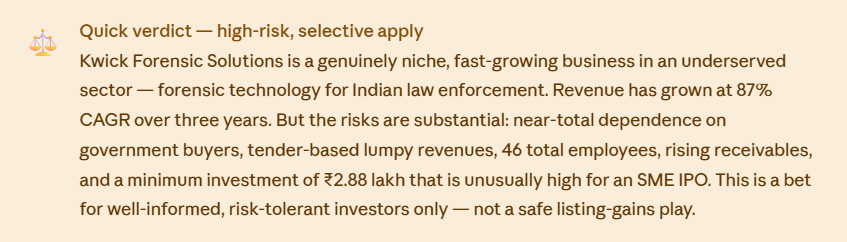
The company operates in a sector that rarely makes it to Dalal Street. Forensic technology is a genuine public safety necessity — but it’s almost entirely government-funded, government-tendered, and government-timed. That creates the fundamental investment question: is the 87% revenue CAGR a sign of durable competitive positioning, or is it a temporary surge from a few large government contracts that may not repeat?
IPO snapshot — The Key Details
share
(56.41 lakh shares)
OFS
per lot)
investment (2 lots)
date — BSE SME
The financials: Explosive Growth
Kwick Forensic’s revenue trajectory is genuinely striking. Revenue grew from ₹30.18 crore in FY24 to ₹105.71 crore in FY26 — an 87% CAGR over just two years. Profitability followed, with PAT growing from ₹2.83 crore in FY24 to ₹13.51 crore in FY26. Operating cash flows turned positive in FY25 at ₹4.65 crore and improved further to ₹7.62 crore in FY26, after being negative in FY24.
| Metric | FY24 | FY25 | FY26 |
|---|---|---|---|
| Revenue (₹ Cr) | 30.18 | 64.87 | 105.71 |
| PAT (₹ Cr) | 2.83 | 8.55 | 13.51 |
| PAT margin | 9.38% | 13.16% | 12.78% |
| Revenue growth YoY | — | +115% | +63% |
| PAT growth YoY | — | +202% | +58% |
| Operating cash flow | −₹2.61 Cr | +₹4.65 Cr | +₹7.62 Cr |
| 3-yr revenue CAGR | ~87.14% (FY24–FY26) | ||
Two nuances deserve attention. First, PAT margin declined marginally from 13.16% to 12.78% in FY26 even as revenue grew 63% — a small but noteworthy sign that scale is not improving margins proportionately, which is a concern for a business that claims pricing power through specialisation. Second, while operating cash flows have turned positive, the business is still working-capital intensive — which is why ₹48 crore of the ₹51 crore raised goes entirely to working capital, not to capacity expansion or technology development.
That working capital intensity has a structural cause: government customers pay slowly. Receivable cycles for tender-based government business in India can stretch 90–180 days, sometimes longer. As revenue grows, the receivables book grows proportionately — requiring more and more working capital to sustain operations. The IPO is essentially funding that receivables gap.
Revenue Breakdown: Four segments, One Dominant Risk
Physical Evidence
Forensics
Equipment Rental
revenue
The DNA forensics segment is the standout growth story — from ₹0.43 crore in FY24 to ₹11.38 crore in FY26 is a 26× jump in two years. India’s national DNA database initiative and the Criminal Procedure (Identification) Act, 2022 have created government-mandated demand for DNA evidence collection and storage infrastructure across all major police departments. Kwick is among the early movers supplying this infrastructure, which explains the explosive growth in this segment.
Product sales accounted for 91.08% of FY26 revenue — service revenue is only 8.92%. This is important because product revenue (especially equipment) tends to be lumpy and project-specific, while service revenue (rental, MRO, manpower support) provides more stable recurring cash flows. The service revenue base is still small — building it out would significantly improve earnings quality.
Where the money is going
Use of IPO proceeds: ₹48 crore (~94%) goes to working capital; ₹3 crore for general corporate purposes. This is one of the most working-capital-heavy IPO structures we’ve seen in the SME segment. There is zero allocation to manufacturing expansion, new technology, R&D, or market development. The entire raise is essentially to fund the receivables gap from faster-growing government contracts. This is not automatically a red flag — it reflects how government-tender businesses work in India — but it does mean the IPO is funding operational continuity rather than strategic transformation.
The Core Investment Risk
The government dependency problem:
🚨 Almost the entire business depends on government buyers. Kwick Forensic sells primarily through GeM (Government e-Marketplace), state government e-procurement portals, and direct quotations. Every major customer is a government entity — police departments, forensic labs, state bureaus. This creates five compounding risks: (1) revenues are lumpy — large orders arrive then stop; (2) payment cycles are long — 90–180 days is normal; (3) orders can be delayed or cancelled by budget decisions or election cycles; (4) competition is on price — GeM mandates competitive bidding, which compresses margins over time; and (5) a change in government policy or procurement norms can instantly affect the entire business. A company with 46 employees serving one category of buyer with this risk profile demands careful due diligence before investing ₹2.88 lakh.
The company’s dependence on foreign OEM suppliers — Sirchie, Thermo Fisher Scientific, and Rapiscan — adds another layer of risk. A significant portion of the business involves importing specialised forensic equipment and reselling or integrating it for Indian law enforcement. If any of these OEM relationships ends, or if import duties change significantly, the product portfolio is affected. The government’s push for “Make in India” in public procurement is also a double-edged sword: it may benefit Kwick’s locally-manufactured products but threaten its imported equipment business.
The GMP Reality Check
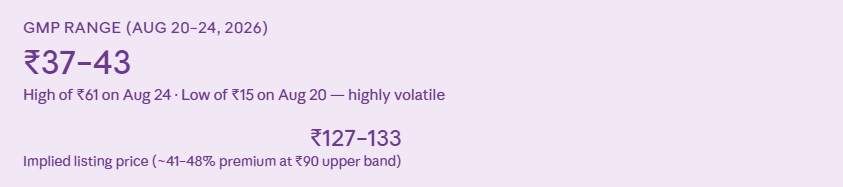
The GMP story for Kwick Forensic is one of the most volatile we’ve tracked this season. It opened at ₹15 on August 20, surged to ₹61 on August 24, and has settled in the ₹37–43 range heading into subscription. That’s a 4× swing in five days — driven entirely by grey market speculation, not fundamental news.
At the current GMP of ~₹43 on a ₹90 upper band, the implied listing price is approximately ₹133 — a 48% premium. That sounds exciting, but remember: GMP for this IPO recorded a high of ₹61 and a low of ₹15 within the same week. This level of volatility in grey market pricing is a signal of speculative activity rather than informed valuation — the ₹2.88 lakh minimum investment means very few retail participants are in the grey market for this IPO, making it susceptible to thin-market manipulation. Treat the GMP as a rough sentiment indicator only.
Key Dates
Bottom Line
Kwick Forensic Solutions is a rare and genuinely interesting business — a 21-year-old forensic technology company that has found itself in exactly the right place as India’s law enforcement apparatus modernises. The revenue growth is real: ₹30 crore to ₹105 crore in two years is not a fabrication — it reflects genuine contract wins across physical forensics, cyber forensics, and the rapidly expanding DNA forensics segment driven by legislative mandates.
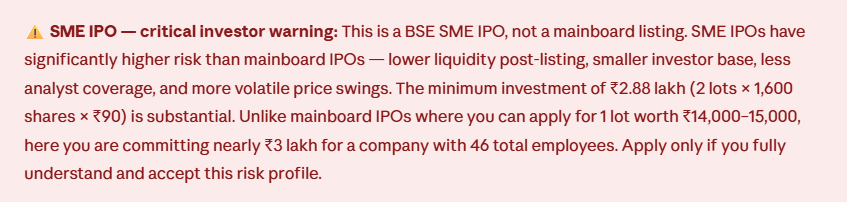
But the risks are equally real and specifically concentrated. This is a 46-employee company where almost every rupee of revenue comes from a single category of buyer — Indian government agencies — through a tender-based procurement model that produces lumpy, slow-paying, policy-sensitive revenues. The entire IPO raise goes to working capital, not growth. And you need to write a ₹2.88 lakh cheque for a BSE SME listing where post-listing liquidity is uncertain.
The honest investor guidance: listing-gain investors may apply if GMP and subscription demand remain healthy; long-term investors may consider the IPO selectively and monitor order inflows, receivables, and margins after listing. That’s the right framing. If you apply, go in with eyes open — know exactly what you own, why you own it, and at what price you’re willing to exit.
Disclaimer: This article is for informational and educational purposes only. Financial figures are sourced from the company’s RHP/DRHP filing and publicly available IPO research. GMP is unofficial, unregulated by SEBI, and not a reliable indicator of listing performance. SME IPOs carry significantly higher risk than mainboard IPOs. This is not investment advice. Please read the full RHP and consult a SEBI-registered financial advisor before applying.
Read More: Tempsens Instruments (India) IPO Analysis: Should You Apply?
Pingback: NSE IPO 2026: India's Biggest-Ever Listing - The EquityVerse