
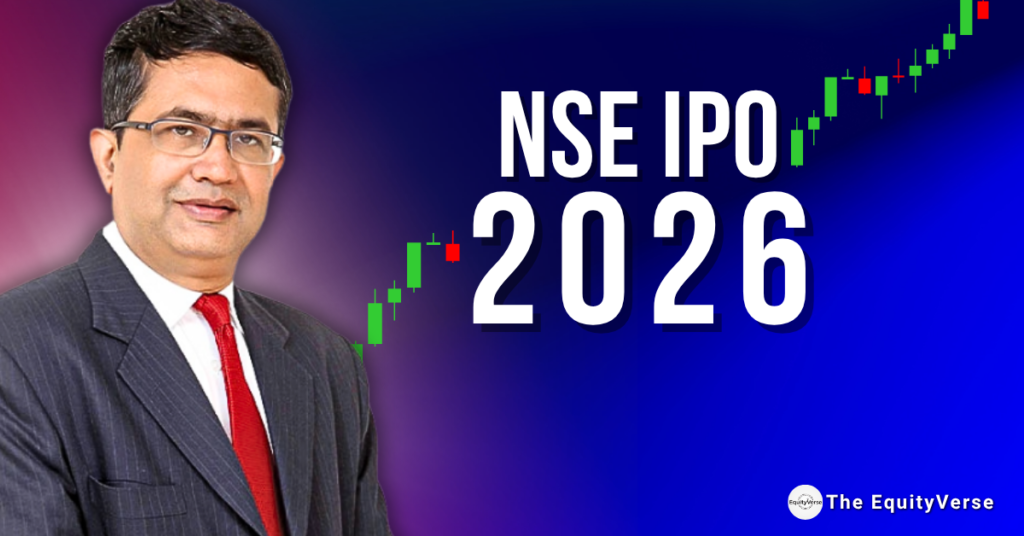
SEBI approved the NSE IPO on September 4, 2026. Subscription opens September 15. Listing targeted September 25. At ₹30,000 crore, this is India’s largest IPO in history — and one of the most nuanced investment decisions you’ll make this year.

Why this IPO is different from every other
Every year has its landmark IPO. 2022 had LIC. 2024 had Hyundai Motor India. 2026 has NSE — and it is categorically in a different class. NSE is not just another large company going public. It is the infrastructure of Indian capitalism itself — the system through which every equity trade in India is routed, priced, and settled. Owning NSE shares means owning a stake in the toll booth that every stock market participant — retail investor, FII, mutual fund, HNI, broker — pays on every single trade, every single day.
The IPO has been 10 years in the making. NSE first filed its DRHP in 2016. What followed was a decade of regulatory scrutiny, legal battles, governance investigations, and a ₹1,491 crore settlement with SEBI over the co-location and dark-fibre controversies. The Supreme Court’s dismissal of SEBI’s appeals in August 2026 — removing the final legal overhang — is what made SEBI’s September 4 approval possible. This is not just a company going public. It is a decade-long saga finally reaching its resolution.
NSE IPO in Numbers
Cr
2,300
The OFS structure — what it means for you: This is a 100% Offer for Sale. Not a single rupee of the ₹30,000 crore raised goes to NSE as a company. Every rupee goes to the selling shareholders — existing institutions and promoters partially exiting their stakes. This means: NSE does not benefit financially from the listing. The IPO does not fund any growth capex, technology, or expansion. You are buying existing shares from existing owners — not subscribing to the company’s future growth capital. This doesn’t make the IPO bad — it simply means you need to evaluate NSE on the merits of what it already is, not on what it plans to build with IPO proceeds.
The Decade-Long Journey to Listing
2026
2026
The Financials
NSE’s financials tell two stories simultaneously — the extraordinary underlying business, and a difficult FY26 caused almost entirely by SEBI’s regulatory tightening of India’s derivatives markets.
| Metric | FY24 | FY25 | FY26 | Q1FY27 |
|---|---|---|---|---|
| Revenue from ops (₹ Cr) | 14,778 | 17,141 | 16,601 | 4,560 |
| Revenue YoY growth | — | +16% | −3.1% | −8% QoQ |
| Profit after tax (₹ Cr) | — | 12,188 | 10,302 | 3,120 |
| PAT YoY growth | — | — | −15.5% | +6.7% YoY |
| Net profit margin | — | — | 55.05% | — |
| EBITDA margin (normalised) | — | — | 75.48% | — |
| Return on Equity (RoE) | — | — | 32.98% | — |
| Revenue CAGR (FY22–FY26) | 20.5% over 4 years | |||
| FY26 dividend paid | ₹35/share (including special one-time component) | |||
The FY26 decline demands explanation — because understanding it is the most important analytical task before applying. NSE’s revenue fell 3.1% and profit fell 15.5% in FY26. This happened almost entirely because SEBI tightened derivatives regulations: fewer weekly expiries, higher lot sizes, true-to-label charges on options contracts. These measures reduced retail and HNI options trading volumes — which directly hit NSE’s transaction fee income, its single largest revenue driver.
Here is the structural concentration that caused the problem:
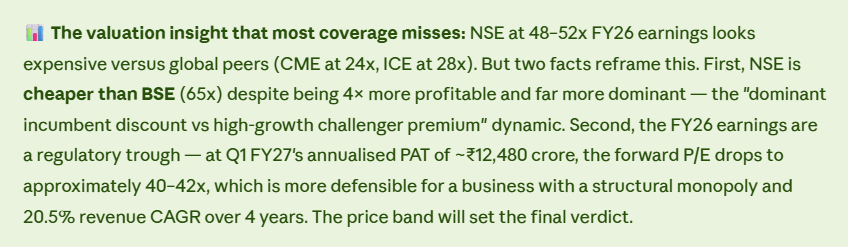
The good news from Q1 FY27: revenue of ₹4,560 crore is up 13.1% YoY from Q1 FY26’s ₹4,032 crore, and net profit of ₹3,120 crore is up 6.7% YoY. The derivatives market appears to be stabilising post-SEBI’s regulatory reset — suggesting FY26 may have been the trough. If Q2 and Q3 FY27 continue this recovery, the IPO arrives at a potentially attractive re-entry point into NSE’s earnings cycle.
The Monopoly Metrics of NSE
These numbers place NSE in a category shared by perhaps five businesses in the world. A 55% net margin means NSE keeps 55 paise of every rupee it earns as profit — after paying all costs, salaries, technology, and taxes. The Nifty 50 index alone is among the world’s most valuable financial brands — every mutual fund, ETF, and structured product referencing the Nifty pays NSE a licensing fee. CME Group, the global benchmark, runs at 21% net margins. NSE at 55% reflects the economic reality of an essentially uncontested domestic monopoly.
market share in
India
market share
derivatives
exchange
(contracts traded)
derivatives market
share by contracts
— extraordinary
for any business
— best-in-class
globally
on NSE
indices including
Nifty 50
portfolio / treasury
book
The Bull Case: NSE is Extraordinary Investment
🏛️ Unbreakable structural moat — liquidity begets liquidity
Stock exchanges are natural monopolies because traders, brokers, and market makers all congregate where liquidity is deepest. With 93% cash equity and 99.79% equity futures market share, NSE has achieved a liquidity depth that no competitor can match. Even if a competitor offered lower fees, traders wouldn’t move — the execution quality at NSE is simply better because more volume flows through it. This moat is nearly impossible to erode.
📈 India’s Equity participation story has decades to run
Only about 8–10% of Indian households own equities directly or via mutual funds — versus 55%+ in the US. As India’s middle class grows, financial literacy improves, and digital access expands, the base of market participants will grow for decades. Every new demat account, every new SIP, every new derivatives trader pays a toll to NSE. The company doesn’t need to win market share — it just needs India’s markets to grow, which they will.
🔄 F&O curbs are a one-time reset, not a permanent impairment
The SEBI derivatives tightening that caused FY26’s revenue and profit decline was a specific, time-bounded regulatory event — not a structural change in how markets operate. Q1 FY27 already shows YoY revenue recovery of 13.1%. As the market adapts to new lot sizes and weekly expiry structures, derivatives volumes are stabilising. The trough-to-recovery dynamic is the fundamental investment case for applying in September 2026.
💰 ₹3 lakh crore investment portfolio
NSE’s balance sheet holds approximately ₹3 lakh crore in investments — primarily government securities, high-rated bonds, and mutual fund units. This portfolio generates substantial “other income” that supplements operating revenue. It also means NSE has an enormous capital buffer that protects against any near-term earnings dip without affecting operations. Very few listed companies in India carry this level of financial cushion relative to their size.
The Bear Case: Risks every Investor must Understand
⚖️ SEBI is both the regulator AND a selling shareholder
NSE is regulated by SEBI. SEBI also owns shares in NSE (through its regulatory bodies). NSE is listing on BSE — its own competitor. These structural conflicts are unlike anything in the listed company universe. The governance of a listed NSE will require careful watching — any future regulatory action on NSE’s business directly affects the share price of a company that SEBI regulates and in which it has financial interest.
📉 60% of Revenue from Equity options
FY26 proved what happens when SEBI tightens F&O rules: revenue falls 3%, profit falls 15%. The exchange’s dominant earnings driver sits directly under the regulator’s thumb. Any future policy change — additional curbs on weekly expiries, margin requirements, or transaction charge caps — could replicate or worsen FY26’s dip. An investor in NSE is implicitly taking a view on SEBI’s future derivatives policy.
💸 100% OFS — Zero Growth Capital
Every rupee of the ₹30,000 crore raised exits NSE’s shareholder registry and goes to selling institutions. NSE gets nothing. The listing creates price discovery and liquidity for shareholders, but it does not add capital, capability, or competitive advantage to the business. Unlike a fresh issue IPO, there is no “this capital will fund X growth initiative” story here.
🏆 BSE is a faster-growing challenger
BSE’s PAT grew ~88% in FY26 while NSE’s fell 15%. BSE has been the unexpected beneficiary of SEBI’s F&O curbs — particularly gaining Sensex weekly options market share. If this growth differential persists, BSE at 65x could prove to be the better exchange stock despite trading at a higher P/E — because its earnings growth rate is higher. NSE’s valuation discount to BSE is not guaranteed to close quickly.
🔐 Governance History
NSE paid ₹1,491 crore to settle the co-location and dark-fibre cases — admitting to lapses that gave certain brokers an unfair trading advantage for years. While the Supreme Court’s dismissal of SEBI’s appeals is a legal resolution, it is not an exoneration. Institutional investors outside India — particularly governance-focused US and European pension funds — may apply a discount for this history until NSE demonstrates several years of clean post-listing governance.
Key Dates — Mark your Calendar
Bottom Line
The NSE IPO is the most important Indian market event of this decade. Whether or not you apply, understanding what NSE is and how it works makes you a better investor — because this is the machine that prices and settles every equity you will ever buy or sell in India.
The business case is extraordinary. A 55% net margin monopoly with 93% market share, a ₹3 lakh crore investment portfolio, and structural tailwinds from India’s expanding investor base — this is not a company you will see listed on Indian exchanges again. This is a one-time event.
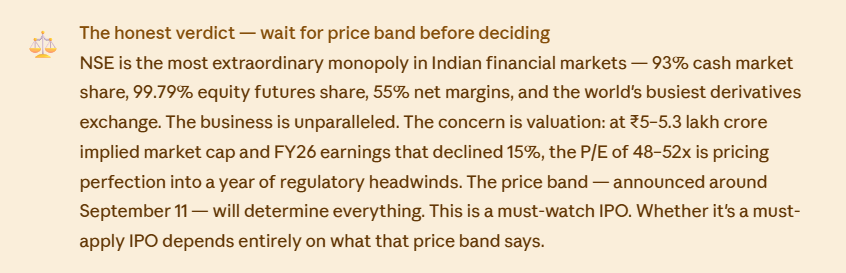
The valuation case depends entirely on the price band. At ₹2,100–2,300/share and ₹5–5.3 lakh crore market cap, the implied P/E of 48–52x on trough FY26 earnings is demanding — defensible for a monopoly in recovery, but demanding. If the price band comes in below ₹2,000 per share — implying sub-40x earnings — the margin of safety improves meaningfully and the apply case strengthens dramatically.
The action plan for every retail investor: wait for September 11, calculate the P/E at the announced price band, compare it to BSE’s current multiple and global exchange peers, and then decide. Don’t let the hype of India’s largest-ever IPO override the basic discipline of buying at a rational price. NSE has been worth waiting for since 2016. Ten more days to the price band is nothing.
Disclaimer: This article is for informational and educational purposes only. All financial figures are sourced from NSE’s DRHP (filed June 17, 2026), Business Standard, BusinessToday, StockEdge, and other publicly available sources as of September 5, 2026. The price band has not been officially announced. Valuation figures are based on indicative unlisted market prices and will change at the official price band. This is not investment advice. Please read the full RHP when available and consult a SEBI-registered financial advisor before applying.
Read More: Kwick Forensic Solutions SME IPO
Pingback: Pranav Constructions IPO Analysis: Should You Apply? - The EquityVerse