
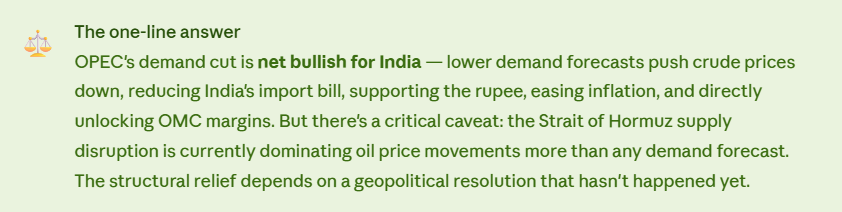
On August 12, OPEC slashed its 2026 oil demand growth forecast to 580,000 barrels per day — the fourth straight monthly downgrade. For India, which imports 85% of its oil, this matters enormously. Here’s what it means for your OMC stocks, airline holdings, paints sector, and broader portfolio.
What exactly did OPEC say?
On Wednesday, August 12, 2026, OPEC published its August monthly oil market report — and it delivered its fourth consecutive downward revision to the 2026 global oil demand growth forecast.
(August report)
— now cut by 200K bpd
revision in 2026
— actual demand decline
— fell below $89/bbl
week ending August 7
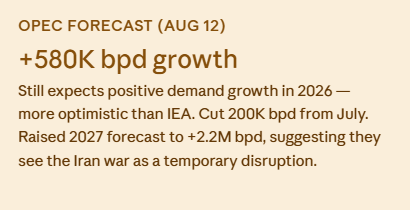
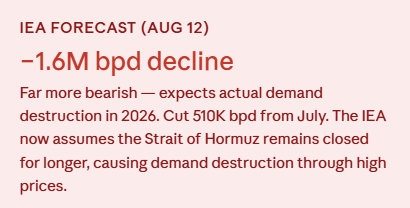
The divergence between OPEC and IEA is striking and deliberate. OPEC, as a producers’ group, has a structural incentive to project higher demand — it justifies production levels and price floors. The IEA, representing consuming nations including India’s interests, is projecting far deeper damage to global oil consumption from the Hormuz-driven price spike. For Indian investors, the IEA’s demand destruction scenario is actually the more bullish one — because demand destruction typically means lower oil prices ahead.
The Revision Timeline: How OPEC’s Forecast Collapsed in 2026
The pattern is clear: India is explicitly named as a contributor to the downward revision, alongside China and broader Asia. This means OPEC itself is acknowledging that higher oil prices from the Hormuz disruption are destroying demand in India — people and businesses are consuming less fuel because it costs more. That demand destruction is the painful but necessary precursor to eventual price normalisation.
The India Ripple Effect: How lower Oil Demand Translates to your Portfolio
📉 Lower crude = smaller import bill = rupee support
Every $10 fall in crude prices reduces India’s current account deficit by approximately $14–15 billion (0.4% of GDP). With Brent now testing $88 versus its May 2026 peak above $100, the import bill has already started moderating. A sustained fall toward $80 would be transformational — potentially reversing the rupee’s 2026 depreciation and reducing imported inflation by 40–60 basis points on CPI.
🏭 OMC margins unlock — the most direct stock market beneficiary
BPCL, HPCL, and IOC’s profitability is inversely correlated with crude prices. When crude is above $100 and government price controls prevent retail fuel price hikes, OMCs absorb the margin loss directly. As crude falls toward $85–90, the government’s pricing formula allows OMCs to earn positive gross refining margins again — turning what were margin-eroding quarters into profitable ones. This is the single most direct portfolio impact of lower oil.
✈️ Aviation fuel costs fall — IndiGo and Air India breathe easier
ATF (Aviation Turbine Fuel) constitutes roughly 35–40% of airline operating costs. IndiGo fell 3.2% when crude spiked above $100 in May; it should benefit symmetrically as crude moderates. Each $10 fall in crude saves the Indian aviation industry hundreds of crores annually in ATF costs — directly supporting earnings recovery for IndiGo (InterGlobe Aviation), the only listed pure-play airline in India.
🎨 Paints and chemicals see raw material cost relief
Asian Paints, Berger Paints, Pidilite, and SRF all depend heavily on petrochemical derivatives — crude oil’s downstream products — as raw materials. Titanium dioxide, monomers, solvents, and resins all track crude with a 1–2 quarter lag. Lower crude in August–September typically translates into better gross margins for paints companies in Q3 and Q4 FY27 — creating a positive earnings revision cycle for a sector that was under significant cost pressure at $100+ crude.
🏦 RBI rate cut probability rises
Lower crude directly reduces CPI inflation — removing one of the key constraints that kept the RBI from cutting rates aggressively in 2026. If crude sustains below $85–90, the RBI’s inflation trajectory improves meaningfully, potentially enabling 1–2 additional 25bps rate cuts in H2 FY27. Rate cuts are a broad positive for equities — particularly rate-sensitive sectors like real estate, consumer durables, and NBFCs.
🛢️ ONGC and Oil India see headwinds — but limited
Upstream producers benefit from high oil prices and suffer when they fall. ONGC and Oil India, which benefited from crude above $100, will see some earnings pressure as crude moderates. However, their government ownership and strategic importance typically provide a floor — and at $80–85 crude, they remain comfortably profitable. The headwind is real but not severe unless crude falls below $70, which most forecasts don’t currently project.
Sector Impact Scorecard
| Sector | Impact | Why — and what to watch |
|---|---|---|
|
Oil Marketing Companies
BPCL, HPCL, IOC
|
Bullish | Lower crude supports margin recovery. Under-recoveries shrink or turn positive. Watch Q2 FY27 GRMs as the first signal of sustained profitability. |
|
Aviation
IndiGo (InterGlobe)
|
Bullish | ATF represents 35–40% of operating costs. Crude near $85 instead of $100 can significantly improve margins, while air travel recovery remains supportive. |
|
Paints & Coatings
Asian Paints, Berger, Indigo
|
Bullish (Lagged) | Petrochemical raw material costs typically fall with a 1–2 quarter lag. Gross margin expansion is more likely in Q3–Q4 FY27. |
|
Specialty Chemicals
Pidilite, SRF, Aarti Industries
|
Bullish (Lagged) | Feedstock costs moderate as crude declines. Companies with fixed-price contracts benefit first, while spot buyers gain over the following quarters. |
|
FMCG
HUL, ITC, Nestlé, Marico
|
Moderately Bullish | Lower packaging, logistics, and palm oil costs support margins. Consumer spending power may improve if fuel inflation moderates. |
|
Logistics & Transport
Blue Dart, Delhivery, VRL
|
Bullish | Diesel is a major operating cost. Lower fuel prices directly improve shipment margins and transport profitability. |
|
Upstream Oil & Gas
ONGC, Oil India
|
Mild Headwind | Revenue per barrel declines as crude prices soften. Earnings may underperform if realized prices remain below earlier expectations. |
|
Banking & Financials
HDFC Bank, ICICI Bank, Axis Bank
|
Indirect Positive | Lower inflation can increase the probability of RBI rate cuts. Near-term NIM pressure may be offset by stronger credit growth over 6–12 months. |
|
IT & Tech
TCS, Infosys, HCL Tech
|
Neutral | Direct crude exposure is limited. A stronger rupee on lower oil prices could slightly reduce INR-reported dollar revenues. |
The Critical Caveat: Hormuz Still Calls the Shots
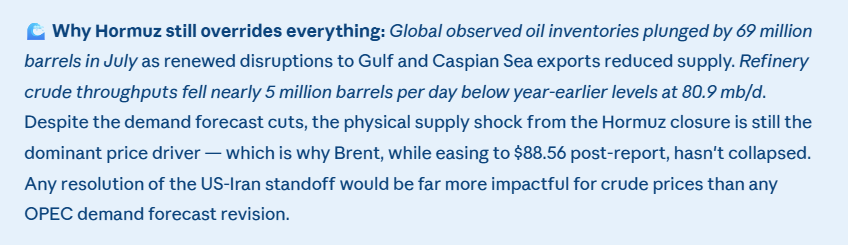
Here is the most important thing to understand about OPEC’s demand cut and what it means for oil prices: demand forecasts don’t move crude prices in isolation — supply does, and right now supply is the dominant variable.
Despite OPEC’s demand downgrade and the IEA’s even bleaker forecast, Brent crude has not collapsed. It fell from $101 in May to $88.56 after the August 12 reports — a meaningful move, but not the dramatic correction that a pure demand destruction story would suggest. Why? Because the Strait of Hormuz supply disruption is simultaneously removing hundreds of millions of barrels from global markets. Global observed oil inventories plunged by 69 million barrels in July alone. Lower demand and lower supply are partially offsetting each other.
The scenario that unlocks the full bullish case for India — crude falling toward $70–75 — requires both the demand destruction to continue AND a Hormuz resolution that reopens supply. That combination hasn’t happened yet. Until it does, the lower demand forecast is a partial positive, not a complete one.
Bottom Line
OPEC’s fourth consecutive demand downgrade is unambiguously good news for India in the medium term — it signals that the price destruction from the Hormuz crisis is feeding back into lower consumption globally, which will eventually pull crude prices down toward a more sustainable range for India’s import-heavy economy.
The direct portfolio beneficiaries are clear: OMC stocks (BPCL, HPCL, IOC) as margin recovery plays, aviation (IndiGo) as an ATF cost play, paints and chemicals (Asian Paints, Pidilite) as lagged raw material cost plays, and rate-sensitive sectors as the RBI’s room to cut rates expands. The headwinds for ONGC and Oil India are real but manageable.
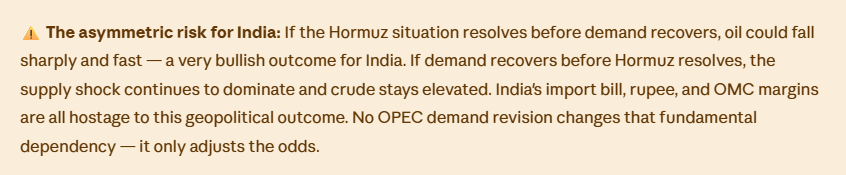
The timing wildcard is the Strait of Hormuz. If the US-Iran standoff resolves, crude could fall sharply and trigger a market-wide relief rally with India as one of the biggest beneficiaries among emerging markets. If it doesn’t, OPEC’s demand forecast will keep getting cut — and crude will keep falling through demand destruction anyway, just more slowly and more painfully. Either way, the direction for India is improving. The pace is the only question.
Disclaimer: This article is for informational and educational purposes only. Oil price forecasts and OPEC/IEA data are sourced from Reuters, OilPrice.com, Xinhua, and IEA publications as of August 12–14, 2026. Stock references are for educational illustration only and do not constitute buy/sell recommendations. Consult a SEBI-registered financial advisor before making investment decisions.
Read More: Gold at ₹1.45 Lakh? The Case For & Against Buying Gold Right Now
Pingback: Skyways Air IPO: Should you board this? - The EquityVerse