
Gold has already crossed ₹1 lakh. It’s now at ₹1.45 lakh per 10 grams — and ICICI Bank says it could hit ₹1.8 lakh by year-end. Before you buy, here’s what every Indian investor needs to understand: the real case for and against, and the smartest way to get exposure if you decide to.
(July 25, 2026)
per troy ounce
(July 2025 to July 2026)
(from May 13, 2026)
2026 year-end target
in India
Gold’s Extraordinary Journey
To understand where gold is going, you first need to understand how we got here — because the story is more dramatic than most financial media has captured.
What the Institutions are forecasting
Here’s where the biggest names in global finance are projecting gold by end-2026 and what it translates to in Indian rupee terms at current exchange rates:

The Case for Buying Gold right now
🟢 The bull case — 6 reasons to buy
- Rupee depreciation multiplier: A 7% rupee depreciation in 2026 alone has directly added to domestic gold prices. With oil above $100 and CAD widening, the rupee faces continued pressure — making domestic gold returns structurally higher than global gold returns for Indian investors
- Central bank buying floor: China, India, Turkey, and the Gulf states are buying gold consistently every month to diversify foreign reserves away from the US dollar. This institutional buying creates a price floor that wasn’t present in previous gold cycles
- Stagflation hedge: Gold historically outperforms in stagflationary environments — high inflation combined with weak growth. With India’s inflation projected at 6.9% and global growth concerns rising, conditions mirror the 1970s stagflation that drove gold’s last great secular bull market
- Customs duty: a structural floor for India: The 15% import duty means international price drops are partially absorbed domestically. This asymmetry means Indian gold investors enjoy more upside than downside relative to global moves
- Portfolio insurance is cheap now: Gold corrected 15% from its January 2026 all-time high before recovering. At ₹1.45 lakh, it’s ~18% below the ATH — not at the absolute peak, providing some margin of safety for fresh buyers
- 60-year CAGR of 13.38%: Gold in India has delivered 13.38% CAGR over 60 years — outperforming fixed deposits, matching inflation-adjusted equity returns in some periods, and doing so with near-zero counterparty risk
🔴 The bear case — 6 reasons to be cautious
- You’re buying after a 90% one-year rally: Gold has already risen ~90% in the past 12 months. Buying any asset that has doubled in a year carries significant mean-reversion risk — the January 2026 ATH followed by a 15% correction is a recent reminder of how fast that can happen
- Gold pays no income: Unlike equity (dividends), bonds (interest), or real estate (rent), gold generates zero cash flow. Every rupee in gold is a rupee not compounding through income-generating assets. At 8 years, an SIP in Nifty historically returns more than gold with additional dividend income
- A US-Iran resolution ends the premium: A significant portion of gold’s current pricing reflects geopolitical risk premium around the Strait of Hormuz. Any credible peace deal or reopening of shipping lanes could trigger a sharp 10–15% correction in gold prices globally within weeks
- Dollar strength is a headwind: Gold fell 15% when the dollar strengthened after the West Asian conflict began. Since gold is priced in dollars globally, a Fed rate pause reversal or renewed dollar strength could hit gold prices significantly even if rupee remains weak
- Jewellery demand has collapsed: World Gold Council data shows jewellery demand fell 23% globally in Q1 2026 — the largest single-quarter drop in recent history. When the largest end-use segment sees such a sharp demand decline, it signals price sensitivity at current levels that could cap upside
- Opportunity cost at peak equity discounts: Indian equity markets are down significantly YTD, with Nifty near multi-year valuation lows on a relative basis. The risk-reward for equities at these levels may actually be better than gold for a 5–7 year horizon investor
SGBs, Gold ETFs & Physical Gold: which is best in 2026?
This is the question most Indian investors ask second, after “should I buy gold?” — and the answer has changed significantly in the past 18 months. Here’s the complete, up-to-date comparison:
| Factor | Sovereign Gold Bond (SGB) | Gold ETF / Gold Fund | Physical Gold |
|---|---|---|---|
| Availability Today |
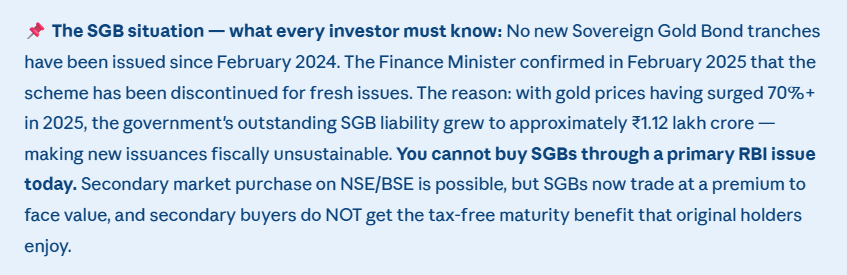
Secondary market only; no new issues since Feb 2024
Discontinued |
Fully available; buy/sell anytime through demat
Best Option |
Available at any jeweller or bank
With Caveats |
| Returns | Gold price appreciation + 2.5% annual interest (original holders only) | Gold price appreciation only; no interest income | Gold price appreciation only; minus making charges (5–25%) |
| Tax on Gains |
Tax-free at maturity (original holders). Secondary buyers: 12.5% LTCG
Best for Original Holders |
12.5% LTCG after 12 months (if bought after Apr 1, 2025); income taxed as per slab for STCG |
12.5% LTCG after 24 months + 3% GST on purchase
Worst Tax Treatment |
| Entry Cost | Secondary market premium over face value; no GST |
Expense ratio approximately 0.1–0.5% p.a.; no GST
Lowest Cost |
Making charges (5–25%) + 3% GST
Highest Cost |
| Liquidity | Exit after 5 years on coupon dates; secondary market available but limited volume |
T+1 settlement; buy or sell anytime while markets are open
Most Liquid |
Sell to jeweller (usually at a discount); depends on the local market |
| Storage & Safety | Government-backed; held in demat; zero storage cost | Held electronically in demat; SEBI-regulated; zero storage cost |
Locker cost (₹3,000–8,000/year); theft risk; insurance recommended
Highest Cost & Risk |
| Minimum Investment | 1 gram (secondary market price may vary) |
1 unit (approximately ₹700–800 per unit)
Most Flexible |
Typically 1–10 grams minimum; higher for coins and bars |
| Loan Against Holding | Yes — pledgeable with banks up to approximately 75% LTV |
RBI 2025 directions: loans generally not available against ETF units
New Restriction |
Yes — gold loans available at 65–75% LTV
Best for Loans |
| Best For | Existing holders willing to stay invested until maturity for tax-free redemption. New investors should evaluate secondary market pricing carefully. |
Ideal for investors seeking a regulated, liquid, and low-cost way to invest in gold.
Recommended |
Suitable for jewellery, gifting, and personal use rather than investment returns.
Not for Investment |
The Smart Approach: How to invest in Gold in 2026
1. Use Gold ETFs as your primary vehicle
With SGBs discontinued for new issues, Gold ETFs are the clearest default recommendation for most investors in 2026. They’re SEBI-regulated, low-cost (expense ratio ~0.1–0.5%), fully liquid (T+1 settlement), and track spot gold prices precisely. Options include HDFC Gold ETF, SBI Gold ETF, Nippon India Gold ETF, and Kotak Gold ETF — all virtually equivalent for this purpose. You need a demat account to buy.
2. No demat account? Use a Gold Fund of Funds (FoF)
Gold mutual funds (which invest in Gold ETFs) can be purchased through any mutual fund platform without a demat account — Zerodha Coin, Groww, Kuvera, and others. They carry a slightly higher expense ratio than direct ETFs but are otherwise functionally equivalent. This is the right option for investors who invest primarily through mutual fund SIPs and don’t want to open a separate demat account.
3. Already hold SGBs? Hold to maturity — don’t sell
If you were allocated SGBs at original issue, the tax-free maturity redemption is the last of its kind — no new investor can access this benefit. The 2.5% annual interest plus tax-free capital gains at 8 years makes holding to maturity financially superior to selling on the secondary market in virtually every scenario. Don’t let the current price tempt you into an early exit that forfeits the tax benefit.
4. Stagger your entry — don’t deploy everything at once
At ₹1.45 lakh per 10g after a 90% one-year run, deploying a lump sum into gold carries meaningful timing risk. A monthly SIP into a Gold ETF or Gold Fund over 6–12 months applies the same rupee-cost averaging logic that works for equity — buying more grams when prices dip, fewer when they spike. This is especially important at current elevated price levels where a 10–15% correction (like January 2026) is always possible.
5. Keep gold to 5–10% of your total portfolio
Gold is a portfolio diversifier and hedge, not a core wealth-creation asset. Its 60-year CAGR of 13.38% is respectable, but equity markets over the same period have delivered higher inflation-adjusted returns with reinvested dividends. The right allocation is enough to matter in a crisis — which research consistently puts at 5–10% — without being so large that it drags on long-term compounding when equities are outperforming.
Bottom Line: The Verdict
⚖️ The balanced answer: Gold at ₹1.45 lakh is not a “buy everything now” moment, and it’s not a “avoid completely” moment. The structural bull drivers — rupee depreciation, central bank buying, inflation, and geopolitical risk premium — are real and not going away quickly. But after a 90% one-year rally, buying a large lump sum at current prices carries meaningful correction risk. The right approach for most Indian investors is: build a 5–10% gold allocation via monthly Gold ETF SIPs, hold any existing SGBs to maturity, avoid physical gold for investment purposes, and treat gold as the insurance policy in your portfolio — not the growth engine. If the ICICI Bank forecast of ₹1.5–1.8 lakh proves accurate by year-end, staggered buyers at ₹1.45 lakh today will be rewarded. If the Hormuz crisis resolves, a 10–15% correction is equally plausible. The Gold ETF SIP approach hedges both outcomes.
Disclaimer: This article is for informational and educational purposes only and does not constitute investment advice. Gold price forecasts from Goldman Sachs, J.P. Morgan, ICICI Bank, and other institutions are third-party estimates and not guarantees of future performance. Gold prices in India are subject to global price movements, USD/INR exchange rates, customs duties, and other factors. Consult a SEBI-registered financial advisor before making investment decisions.
Read More: HDFC Bank & ICICI Bank Q1 FY27 Results
Pingback: OPEC Just Cut Its Oil Demand Forecast — Is This Bullish or Bearish for India? - The EquityVerse