
Both declared results on July 18, 2026. Here’s the complete side-by-side breakdown — profit, margins, loan growth, asset quality, dividends — and exactly what each result means for investors holding either stock.

The Big Picture First
India’s two largest private sector banks reporting on the same day is always a major market event — and this quarter carries extra weight. HDFC Bank’s stock has fallen over 17% year-to-date in 2026, weighed down by governance concerns and margin pressure, making this a closely watched results day for its holders. ICICI Bank, meanwhile, has held up considerably better, gaining 3.66% year-to-date, and is coming off a Q4 FY26 where net profit grew 8.48% year-on-year to ₹13,701 crore.
For retail investors holding either stock — or thinking of adding — this quarter’s results answer three critical questions: is HDFC Bank’s recovery on track, is ICICI Bank’s premium valuation justified, and do the results change the case for owning India’s largest private banking names going into the second half of FY27?
Head-to-head: the Key metrics compared
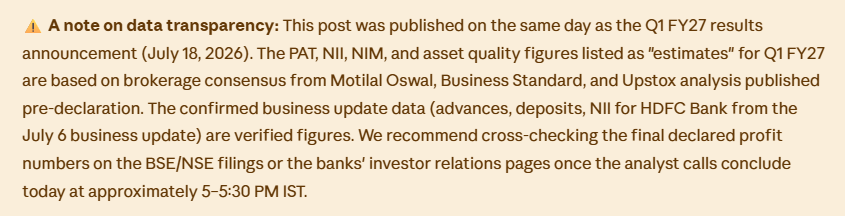
Here is the side-by-side comparison across the metrics that actually matter for retail investors — using confirmed figures where available, brokerage consensus estimates where Q1 FY27 actuals are pending the analyst call:
| Metric | HDFC Bank | ICICI Bank | Edge |
|---|---|---|---|
| PROFITABILITY — Q1 FY27 | |||
| Net Profit (PAT) | Est. ₹18,950–19,230 Cr | Est. ₹12,900–13,100 Cr | HDFC (Absolute Size) |
| PAT YoY Growth | Est. +5–8% | Est. +1–2.5% | HDFC |
| PAT QoQ Trend | Flat vs Q4 | −4–5% QoQ | HDFC |
| CORE INCOME — Q1 FY27 | |||
| NII (Confirmed / Estimated) | ₹39,663 Cr (Confirmed) | Est. +10% YoY | HDFC (Size) |
| NII YoY Growth | +7.3% | Est. ~10% | ICICI (Growth) |
| Net Interest Margin (NIM) | ~3.4–3.5% | ~4.35–4.40% | ICICI |
| LOAN & DEPOSIT GROWTH | |||
| Gross Advances Growth (YoY) | +12.4% (Confirmed) | Est. ~12–14% | Near Parity |
| Deposit Growth (YoY) | +14.7% (Confirmed) | Est. Trail Advances | HDFC |
| CASA Growth (YoY) | +9.4% | TBD | Watch Analyst Call |
| ASSET QUALITY | |||
| Gross NPA Ratio | 1.20% | 1.58% | HDFC (Lower NPA) |
| Net NPA Ratio | 0.40% | Improving Trend | HDFC |
| VALUATION & RETURNS | |||
| Stock YTD Performance | −17% | +3.66% | ICICI |
| Dividend (FY26) | ₹13/share | TBD | HDFC |
| Bonus Issue | 1:1 (Announced) | None | HDFC |
What the numbers actually tell you
📈 HDFC Bank‘s loan growth has genuinely accelerated
Gross advances growing 12.4% YoY to ₹31.27 lakh crore is a strong signal after quarters of below-industry loan growth. Deposits at +14.7% are growing faster than loans — meaning the loan-to-deposit ratio is improving, one of the key concerns institutional investors have tracked. This is the clearest positive from the business update data and deserves to be the headline takeaway, not the governance noise.
⚠️ HDFC Bank’s NIM compression remains the core challenge
With NIM at around 3.4–3.5% — structurally lower than ICICI Bank’s 4.35–4.40% — HDFC Bank is managing a margin squeeze that traces back to the HDFC Ltd merger in July 2023, which brought in a large book of lower-yielding housing loans. Recovery will be gradual. Analysts at Motilal Oswal expect NIMs to remain flat with a 2 basis point QoQ dip due to seasonal agricultural stress. Watch management commentary at the 4 PM analyst call today for any forward guidance on the NIM trajectory.
🏆 ICICI Bank’s NIM advantage is structural, not temporary
ICICI Bank’s NIM of 4.40% in Q4 FY26 is approximately 100 basis points higher than HDFC Bank’s. This gap has widened since the merger and reflects a fundamentally different portfolio mix — ICICI carries a higher share of retail and SME loans (higher yielding) versus HDFC Bank’s large housing and corporate book. For every ₹100 of assets, ICICI earns meaningfully more in net interest — and that shows up in its superior return ratios.
📉 ICICI Bank’s profit may slip QoQ — and that’s expected
Brokerages forecast a 4–5% sequential decline in ICICI Bank’s Q1 PAT, and this is not alarming. Q4 FY26 benefited from unsustainably low provisions; a normalisation was expected. The YoY comparison — flat to +1–2.5% growth — reflects the elevated base set in Q1 FY26 when profit grew a strong 15.5%. This is a “tough base effect” quarter, not a deterioration in the business.
🎁 HDFC Bank’s 1:1 bonus issue is a significant signal
HDFC Bank announced a 1:1 bonus share issue alongside the Q1 FY27 results — the first bonus issue in the bank’s history. For existing shareholders, this doubles the share count and halves the price per share, making the stock more accessible to retail investors. It does not change the economic value of your holding, but it signals management confidence in the earnings trajectory and typically improves trading liquidity and retail participation.
🏛️ Governance concerns are weighing on HDFC Bank — but watch what the numbers say
HDFC Bank’s stock is down over 17% year-to-date in 2026, partly attributed to governance concerns raised by investors. However, the operational business — loan growth at 12.4%, deposits at 14.7%, asset quality stable with GNPA at 1.2% — tells a different story from the stock price. This divergence between business fundamentals and stock price is precisely where value investors look for opportunity, while momentum investors stay away.
The NIM Story: Why it matters more than Profit
For banking stocks, the Net Interest Margin is the single most important metric — more than the headline profit number. Here is why: profit can be inflated by low provisions (as ICICI Bank’s Q4 showed) or deflated by one-time charges, but NIM tells you the underlying spread-based earning power of the bank’s loan and deposit franchise.
compression
HDFC Bank’s NIM has been on a slow recovery path since bottoming out post-merger. The key management guidance to listen for in today’s analyst call: whether the NIM recovery trend is intact heading into Q2 and Q3 FY27, and whether the RBI’s rate trajectory (repo at 5.5% after cuts) is helping or hurting the spread book.
What the Results mean for your Portfolio
HDFC Bank holders
Hold with conviction — don’t sell into weakness
Loan growth at 12.4% and deposits at 14.7% confirm the operational recovery is real. The stock is down 17% YTD, but the business fundamentals are improving. The 1:1 bonus issue and ₹13/share dividend provide tangible near-term returns. Patient investors who look through the governance noise will likely be rewarded as the merger integration completes and NIM recovers toward 3.7–4.0% over FY27–28.
HDFC Bank prospective buyers
This is a value entry point — selectively accumulate
At ₹819 with the stock down 17% and fundamentals intact, HDFC Bank is trading well below its historical valuation range. The post-bonus price (approximately ₹410 adjusted) would make it one of India’s most accessible quality banking stocks for retail investors. Consider staggered buying over 2–3 months rather than a single lump sum before the analyst call today.
ICICI Bank holders
Hold — quality premium is justified
A flat-to-slight profit dip in Q1 on a tough base is expected and telegraphed. ICICI Bank’s 4.40% NIM, superior return ratios, and resilient digital franchise mean the structural story is intact. The stock has held up remarkably well (+3.66% YTD) while peers fell. Don’t read a sequential profit dip as deterioration — it’s a provision normalisation quarter.
ICICI Bank prospective buyers
Fair value — Wait for a better entry on any post-result dip
ICICI Bank is fairly valued after its YTD run. If Q1 results disappoint on NIM or provisions versus estimates, a 3–5% post-result dip would be a better entry opportunity than chasing the stock at current levels. The bank’s 52-week low of ₹1,187.60 vs the current ₹1,387.50 already reflects significant recovery — there’s less margin of safety than HDFC Bank right now.
The Dividend Angle: What Shareholders Should Expect
HDFC Bank has already confirmed a ₹13/share final dividend for FY26 with a June 19, 2026 record date — if you held the stock on that date, you’ve already received this. The bank has also declared a 1:1 bonus share issue, effectively doubling shareholders’ holdings. Combined, this represents a strong direct return to existing investors even as the stock price has been under pressure.
ICICI Bank’s board is meeting today, and any dividend declaration will be filed with BSE/NSE immediately after the meeting. In FY26, ICICI Bank paid ₹10 per share in dividend (against a face value of ₹2) — market watchers expect a similar or marginally higher payout for FY27 given the strong earnings trajectory over the year.
Bottom Line
HDFC Bank and ICICI Bank are telling two different but complementary stories in Q1 FY27. HDFC Bank is a recovery story — loan growth has re-accelerated, deposits are growing faster than loans, asset quality is clean at 1.2% GNPA, and the 1:1 bonus issue plus ₹13 dividend are tangible shareholder returns even as the stock trades 17% below its FY26 peak. The NIM recovery will be gradual, and governance concerns are a real overhang — but for patient investors with a 2–3 year view, this is the kind of entry point that historically rewards conviction.
ICICI Bank is a quality compounder story — higher NIM, superior return ratios, and a stock that has held up far better in a difficult macro year. A sequentially flat Q1 due to provision normalisation doesn’t change the underlying franchise quality. It trades at a premium, and that premium looks justified — but the margin of safety is slimmer than HDFC Bank at current prices.
For investors holding both — the quarter reinforces holding. For those looking to add — HDFC Bank offers better value at current levels. And for those trying to understand why India’s banking sector remains one of the best long-term investment themes in the country: both these Q1 FY27 results, even with modest headline growth, confirm that the credit cycle is healthy, loan demand is robust, and the fundamentals of India’s private banking sector remain intact.
Disclaimer: This article is for educational and informational purposes only. Q1 FY27 PAT and margin figures marked as estimates are brokerage consensus projections; final declared figures should be verified on BSE/NSE or the banks’ investor relations portals. This is not investment advice. Consult a SEBI-registered financial advisor before making any investment decisions. Past performance is not indicative of future returns.
Pingback: Gold at ₹1.45 Lakh? The Case For & Against Buying Gold Right Now - The EquityVerse