

Crude oil has already crossed $100 per barrel — and a barrel of Brent hasn’t looked back. Here’s an honest, sector-by-sector breakdown of what this means for your investments, your rupee, and your financial plan.
Manish Gunwani
CIO – Equity, Bandhan AMC (IIT Madras · IIM Bangalore · 30+ years experience)
Where Crude stands right now — and Why it matters
This isn’t a hypothetical scenario. Crude oil is already well above the $90 threshold that experts like Manish Gunwani have flagged as a tipping point. WTI crude crossed $101 per barrel on May 12, 2026, with the 10-day high reaching $113.63 on May 4 — driven primarily by the near-shutdown of the Strait of Hormuz and the fragile US-Iran ceasefire situation.
Saudi Aramco’s CEO Amin Nasser has warned that the market is losing roughly 100 million barrels of oil supply each week, and that prolonged disruptions could delay market normalisation well into next year. For investors in India, this is not distant geopolitics — it is a direct hit to your portfolio, your purchasing power, and your long-term financial plan.
Here is why: India imports more than 85% of its crude oil needs, making oil a critical macroeconomic variable rather than just an energy input. In FY24 alone, crude oil imports were valued at approximately $180 billion — nearly one-fourth of India’s total imports. When oil spikes, India feels it everywhere — not just at the fuel pump.
WTI CRUDE (MAY 12)
+59.99% vs same time last year
10-DAY HIGH
Reached on 4 May 2026
USD/INR
Rupee under pressure
INDIA IMPORTS CRUDE
Of total oil needs
ADB CRUDE FORECAST
Average for 2026
INFLATION RISK
If oil stays elevated in FY27
The Ripple Effect: How $90+ Oil moves through India’s Economy
Think of oil not as one variable but as the first domino in a long chain. Here’s how a sustained spike above $90 cascades through every layer of the Indian economy — and eventually lands in your portfolio:
🛢️ Step 1: Import bill explodes
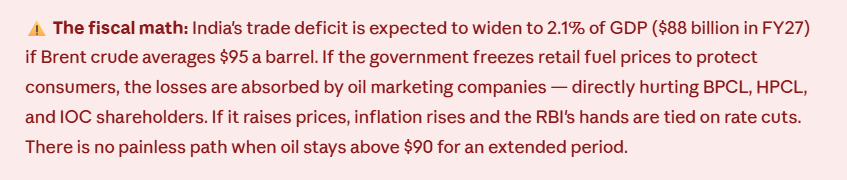
Every $10 rise in crude oil prices widens India’s current account deficit (CAD) by approximately $14–15 billion, or 0.4% of GDP, according to ICRA. At $100+ oil, India’s trade deficit could reach 2.1% of GDP — a level that historically triggers currency stress and capital outflow concerns.
💸 Step 2: The rupee weakens
Higher crude prices lead to larger dollar outflows, weakening the rupee. A depreciating rupee then raises the domestic cost of oil further — a feedback loop that amplifies imported inflation and complicates monetary policy. The Indian rupee depreciated 36 paise to approximately 94.96 against the US dollar when oil spiked in early May 2026.
📈 Step 3: Inflation rises across the board
According to Bank of Baroda research, every 10% increase in crude oil prices pushes WPI (Wholesale Price Index) up by around 0.9%, and CPI (Consumer Price Index) by 40–60 basis points. Analysts project that if oil prices stay elevated, India’s inflation could reach around 6.9% this fiscal year — well above the RBI’s 6% tolerance limit.
🏦 Step 4: RBI is caught in a dilemma
The RBI’s policy challenge becomes delicate: cutting rates too soon could weaken the rupee and worsen inflation pressure, while tightening too much could slow investment and consumption at a time when the economy is already absorbing an external shock. Rate cuts that investors were expecting may now be postponed or cancelled entirely.
🏭 Step 5: Corporate margins compress
Energy-sensitive sectors such as aviation, logistics, paints, chemicals, and FMCG face margin pressure as fuel and raw material costs rise. Companies with strong pricing power may manage better, while businesses serving price-sensitive consumers may struggle to pass on higher costs.
📉 Step 6: Markets turn volatile
Indian stock markets opened sharply lower when oil spiked in early May 2026, with the Nifty 50 slipping 0.85% and the Sensex shedding 0.89%. All 16 major sectoral indices fell, with small-cap and mid-cap stocks dropping about 0.5% each.
Sector-by-Sector Impact: Winners and Losers
Not all stocks react to oil the same way. Here is a clear breakdown of which sectors in India benefit, suffer, and stay broadly neutral when crude sustains above $90:
| SECTOR | IMPACT | WHY |
|---|---|---|
|
Oil & Gas Upstream
ONGC, Oil India
|
Winner | Higher oil prices directly boost revenue and profit realisations for upstream producers. Margins expand significantly when crude stays above key levels. |
|
Renewables & Green Energy
NTPC Green, Adani Green, Torrent Power
|
Winner | Rising oil prices strengthen the investment case for renewable energy and accelerate government support for green infrastructure. |
|
IT & Tech Services
TCS, Infosys, HCL Tech
|
Relative Winner | Dollar revenue benefits IT exporters when the rupee weakens. Energy cost exposure is also lower compared to manufacturing sectors. |
|
Pharma Exports
Sun Pharma, Dr Reddy’s, Cipla
|
Relative Winner | Export-oriented pharma companies benefit from dollar earnings, though raw material costs may partially offset gains. |
|
Banking & Financials
HDFC Bank, SBI, Kotak
|
Mixed | Higher interest rates can support banking margins in the short term, but credit quality risks rise if inflation pressures consumers and businesses. |
|
Infrastructure & Capital Goods
L&T, ABB, Siemens
|
Mixed | Strong government capex supports long-term growth, though higher steel and energy costs may pressure near-term margins. |
|
Oil Marketing Companies
BPCL, HPCL, Indian Oil
|
Loser | Fuel price controls and rising crude costs can compress margins for oil marketing companies when costs cannot be fully passed on to consumers. |
|
Paints & Chemicals
Asian Paints, Pidilite, SRF
|
Loser | Raw material inflation impacts profitability because many inputs are linked to oil derivatives. |
|
Logistics & Transport
Blue Dart, VRL Logistics, Delhivery
|
Loser | Higher diesel prices directly increase transportation and delivery costs, reducing operating margins. |
|
FMCG
HUL, ITC, Nestle, Britannia
|
Under Pressure | Packaging, transportation, and raw material costs rise simultaneously, squeezing margins and consumer spending power. |
|
Jewellery
Titan, Senco Gold, Kalyan Jewellers
|
Loser | Higher gold import costs and weaker consumer sentiment can pressure jewellery demand and company earnings. |
The Government’s Difficult Balancing Act
When oil spikes, the Indian government faces a classic no-win situation: pass the price increase to consumers and risk inflation and political fallout, or absorb it through subsidies and risk blowing the fiscal deficit.
The government has so far relied on advisories — Prime Minister Modi called for citizens to reduce fuel use, limit foreign travel, and buy less gold — rather than adjusting retail prices. Analysts note that this approach addresses an external price shock that is fundamentally harder to control through domestic policy.
Three Oil Price Scenarios
| Scenario | Crude Price Range | Likely Market Impact | Portfolio Implication |
|---|---|---|---|
| Geopolitical resolution — oil falls | $70–80/bbl | Broad market rally; RBI resumes cutting rates | Rotate back into FMCG, banks, real estate, consumer discretionary |
| Current scenario — oil stays elevated | $90–110/bbl | Volatile, sector-driven market; RBI on hold | Stay defensive; overweight IT, pharma, upstream oil; underweight OMCs, aviation, FMCG |
| Hormuz closure worsens — oil spikes further | $115–130+/bbl | Sharp correction; rupee stress; inflation shock | Increase cash/gold/short-duration debt allocation; avoid highly leveraged companies |
The Long-term Silver Lining
Every oil crisis in India’s history has ultimately accelerated progress on reducing oil dependence. The 1973 oil shock fast-tracked domestic refining. The 2008 spike pushed ethanol blending. The current crisis strengthens the argument for a broader energy security strategy, including diversified crude suppliers, strategic reserves, domestic production, renewables, battery storage, and more resilient trade routes.
This means the sectors that benefit from India’s energy transition — renewable energy, electric vehicles, battery storage, and green infrastructure — get an additional policy tailwind every time crude spikes. For long-term investors, the oil shock is an indirect but powerful catalyst for India’s green energy stocks.
Bottom Line
Crude oil above $90 is not a market event you can afford to ignore if you hold an Indian equity portfolio. India imports nearly 85% of its crude oil needs — which means lower oil prices reduce inflation pressure, support the rupee, and improve market sentiment, while higher prices do the reverse. The current environment, with oil above $100 and the Strait of Hormuz under stress, is a genuine macro headwind — not a temporary blip.
But the right response is not panic — it is repositioning. Trim losers, add beneficiaries, hedge with gold, maintain your SIPs, and watch the RBI’s signals carefully. As Manish Gunwani’s warning implies, the investors who act with discipline in macro stress periods are usually the ones who come out ahead when the dust settles.
Disclaimer: This article is for educational and informational purposes only. It does not constitute financial advice or a buy/sell recommendation. All market data is approximate and subject to change. Consult a SEBI-registered financial advisor before making investment decisions. Past performance is not indicative of future returns.
Read More: India’s Defence Stocks Are on Fire — Most Investors Are Still Sleeping
Pingback: Why Sensex & Nifty Are Falling in May 2026 - The EquityVerse